


PFAS Risk in Major Projects: Are Your Assets and Contracts Ready
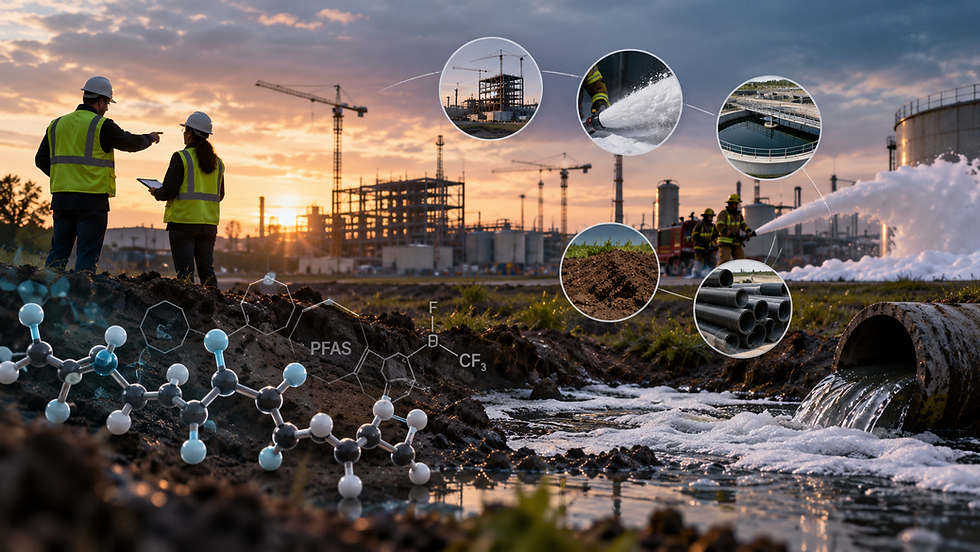
PFAS risk is no longer a narrow environmental compliance issue. It is becoming a project delivery issue, a procurement issue, a contract issue, and an asset valuation issue.
For major projects, the uncomfortable part is timing. PFAS can be present long before a project team arrives, introduced during construction, locked into equipment specifications, or discovered during commissioning, operations, divestment, or decommissioning. By then, the budget, schedule, and contract risk allocation may already be fixed.
Regulators are moving faster than many project controls systems. In the United States, EPA finalized national drinking water standards for several PFAS in 2024 and designated PFOA and PFOS as hazardous substances under CERCLA. Internationally, PFOS, PFOA, and PFHxS are listed under the Stockholm Convention, while the European Chemicals Agency has been considering a broad PFAS restriction under REACH. These actions do not make every PFAS issue identical, but they send a clear market signal. Persistent chemicals are moving from “emerging concern” to measurable liability.
Major projects need to account for that shift before it appears in a change order, permit condition, lender query, insurance exclusion, community objection, or impairment review.
Why PFAS changes the risk profile of major projects
PFAS, or per- and polyfluoroalkyl substances, are a large family of synthetic chemicals valued for oil resistance, water resistance, heat stability, and surfactant properties. Their usefulness explains their reach. PFAS have been used in firefighting foams, coatings, membranes, gaskets, textiles, metal plating, electronics, lubricants, and many specialty industrial applications.
Their persistence explains the risk.
Many PFAS do not break down easily in the environment. Some are mobile in water. Some bioaccumulate. Toxicity varies by compound, and the science continues to develop. That variability can create a false sense of comfort in project settings. Teams may assume that if a substance is not banned today, it carries little commercial risk. That assumption is weak.
The OECD has described PFAS as a broad class of fluorinated substances, and regulatory practice is moving away from managing only a few legacy compounds. EPA’s 2024 drinking water rule covers PFOA, PFOS, PFHxS, PFNA, HFPO-DA, and mixtures of certain PFAS using a hazard index approach. The Stockholm Convention’s listing of PFOS, PFOA, and PFHxS shows that the concern is not confined to one jurisdiction.
The problem for capital projects is that PFAS risk does not align neatly with traditional project categories. It cuts across:
Technical scope Fire systems, water treatment, drainage, materials, coatings, and equipment packages.
Commercial controls Baseline conditions, allowances, contingency, insurance, bonds, and warranties.
Permitting and stakeholder risk Water discharge, soil reuse, waste classification, environmental justice, and community trust.
Long-term value Remediation obligations, operational restrictions, divestment friction, and disclosure.
This makes PFAS different from many familiar environmental issues. A contaminated soil plume can sit in the environmental workstream. A PFAS issue may sit in environmental, process engineering, HSE, procurement, legal, finance, and operations at the same time. If nobody owns the full picture, the project can meet its ESG commitments on paper while creating a liability in the field.
Where PFAS appears across the project lifecycle
PFAS risk rarely arrives as a single event. It is more often a chain of weak signals that teams miss because each one looks manageable in isolation.
A brownfield EPC project may find PFAS in groundwater during baseline investigations. The environmental team flags it, but the construction team sees no immediate excavation issue. Procurement then specifies fluoropolymer-containing components or PFAS-treated materials because they meet performance requirements. Fire protection designs include legacy aqueous film-forming foam assumptions. Wastewater engineers focus on conventional contaminants because PFAS was outside the original basis of design. Months later, the owner receives new permit questions, disposal costs rise, and subcontractors dispute who owns the delay.
That sequence is not unusual in complex delivery environments. The handoffs are where risk grows.
Project stage | Common PFAS risk points | Commercial consequence |
Site selection and due diligence | Legacy firefighting areas, landfills, plating operations, wastewater lagoons, airports, refineries, training grounds | Purchase price adjustments, indemnities, lender conditions, deal delays |
Concept and FEED | Firewater philosophy, drainage strategy, water reuse, soil management assumptions | Scope gaps, rework, underestimated treatment needs |
EPC procurement | Coatings, membranes, gaskets, textiles, specialty chemicals, foam systems, packaged equipment | Supplier substitutions, restricted materials, warranty disputes |
Construction | Dewatering, excavated soil, wash water, temporary fire systems, imported fill | Disposal limits, schedule disruption, unexpected sampling |
Commissioning and operations | Fire system testing, wastewater discharge, sludge, maintenance chemicals | Permit noncompliance risk, operating cost increases |
Decommissioning and divestment | Soil, groundwater, sumps, tanks, firefighting residues, waste classification | Retained liabilities, reduced asset value, transaction friction |
Firefighting systems are a high-signal risk area
Fire protection remains one of the most visible PFAS issues for oil and gas, terminals, chemical plants, airports, military facilities, and large industrial sites. Legacy aqueous film-forming foams often contained PFAS, especially formulations used for hydrocarbon fires.
The operational dilemma is real. High-hazard facilities cannot weaken fire protection. Insurers, regulators, and emergency responders expect credible fire response capability. Yet foam transition is not a simple procurement swap. It may require system cleaning, drain management, foam concentrate replacement, proportioning equipment checks, performance testing, waste disposal, training, and changes to emergency response plans.
A rushed transition can create new risks. Fluorine-free foams may perform differently depending on fuel type, application method, equipment, and site conditions. Engineering judgment matters. IOGP guidance and industry fire protection standards recognize that foam selection must account for hazard type and system performance. At the same time, continued use of PFAS-containing foam can create contamination, disposal, and disclosure exposure.
The leadership question is not, “Have we banned PFAS foam?” It is, “Can the asset demonstrate that its fire protection strategy manages life safety, environmental risk, waste, performance, and regulatory change at the same time?”
Wastewater and sludge can turn small concentrations into large liabilities
PFAS can enter industrial wastewater through process chemicals, contaminated groundwater infiltration, washdown, firefighting residues, leachate, or upstream suppliers. Conventional wastewater systems were not designed to destroy PFAS. Treatment methods such as granular activated carbon, ion exchange, high-pressure membranes, and emerging destruction technologies can reduce or manage certain PFAS, but performance depends on chemistry, influent quality, co-contaminants, and waste handling.
The residuals matter. Spent carbon, brine, membranes, sludge, and concentrated wastes do not disappear. They need disposal, regeneration, incineration, or destruction pathways that satisfy regulatory and contractual requirements. That can change operating costs and create bottlenecks.
For construction projects, dewatering is a frequent blind spot. A project may plan to pump groundwater to a storm system, treatment unit, or sewer under standard assumptions. If PFAS is detected after mobilization, the team may need additional sampling, temporary treatment, storage tanks, hauling, or revised permits. The cost is often less damaging than the schedule uncertainty.
Soil and imported materials create chain-of-custody problems
PFAS in soil can come from prior fire training, surface runoff, biosolids application, industrial spills, landfills, wastewater residuals, or atmospheric deposition. Unlike petroleum hydrocarbons, PFAS may not be obvious from staining or odor. A clean-looking site can still carry PFAS concerns.
Soil reuse decisions are especially sensitive. Moving soil from one part of a site to another can shift liability. Exporting soil can trigger landfill acceptance issues. Importing fill without chemical controls can create future contamination claims. For linear infrastructure, pipelines, transmission corridors, rail, and highways, the challenge is scale. Sampling every area at high intensity may be impractical, but ignoring source-pathway-receptor logic is no longer defensible.
The practical response is risk-based, documented, and tied to decisions. Sampling should support excavation, reuse, disposal, worker protection, water management, and stakeholder assurance. Testing without a decision pathway can create data that nobody knows how to use.
Why conventional ESG governance often misses PFAS
Many companies now have ESG policies, sustainability targets, supplier codes, and enterprise risk processes. Those tools matter. They do not guarantee project control.
PFAS exposes a common gap between corporate commitments and project execution. A company may publish commitments on pollution prevention, water stewardship, biodiversity, circularity, and responsible sourcing. At project level, the same company may rely on old technical specifications, generic hazardous materials clauses, limited supplier declarations, and baseline investigations that exclude PFAS unless regulators require it.
That gap is not hypocrisy by default. It is often a systems problem.
Capital projects run on baselines. Scope, cost, schedule, and risk registers depend on defined assumptions. Emerging environmental liabilities challenge those assumptions because the risk changes while the project is being delivered. Scientific evidence develops. Regulators add compounds. Analytical methods improve. Disposal outlets revise acceptance thresholds. Lenders ask sharper questions. Communities become more informed.
Traditional governance can fail in five ways.
First, PFAS sits below the enterprise risk threshold until it does not. Early signals look technical and localized. A single detection in monitoring data may not reach the executive dashboard. Yet that detection can affect water permits, soil handling, fire system replacement, or transaction value.
Second, procurement data is weak. Many supplier questionnaires ask whether products comply with current law. That is not the same as knowing whether PFAS is present, whether alternatives exist, or whether future restrictions could affect maintainability.
Third, contracts treat contamination as a static condition. PFAS challenges that model. A contractor may price known conditions, not evolving thresholds. An owner may expect compliance with future law, but the contract may not say who pays for redesign, retesting, delay, or disposal if expectations change.
Fourth, ESG reporting can be too aggregated. Frameworks such as GRI, IFRS Sustainability Disclosure Standards, and TNFD encourage disclosure of material impacts, risks, dependencies, and governance. They do not replace asset-level evidence. A group-level statement on water risk will not answer whether a terminal’s foam transition plan is funded or whether a construction project has a PFAS dewatering contingency.
Fifth, accountability is fragmented. HSE owns compliance. Engineering owns design. Procurement owns vendor packages. Legal owns indemnities. Finance owns provisions. Operations owns long-term performance. Nobody owns the cross-functional PFAS risk unless leadership assigns it.
ISO management system standards, including ISO 14001 for environmental management and ISO 31000 for risk management, support structured risk identification and continual improvement. They are useful if applied to real project decisions. Certification alone does not prove that PFAS risk has been understood, priced, and controlled.
The contract problem is bigger than indemnity wording
PFAS risk often becomes a contract dispute because the parties did not convert uncertainty into clear commercial rules.
Environmental clauses commonly address pre-existing contamination, contractor-caused pollution, compliance with law, hazardous materials, waste disposal, and change in law. Those clauses may not answer the questions that matter when PFAS emerges mid-project.
Who pays if PFAS sampling becomes necessary after notice to proceed? Who owns delay from landfill rejection? Does a change in regulator guidance qualify as a change in law? What if PFAS is present in owner-provided water, imported materials, firefighting foam, or a supplier’s component? Who warrants that a “PFAS-free” product is actually free of regulated fluorinated substances, and based on what test method?
EPC and construction contracts need more than broad risk transfer. They need decision rules. Vague allocation can invite claims, defensive behavior, and slow escalation.
Key contract issues include:
Baseline environmental data and reliance rights.
Defined PFAS scope, including specific compounds and classes where appropriate.
Sampling triggers and approved analytical methods.
Responsibility for unknown pre-existing conditions.
Treatment of evolving regulation, permit conditions, and guidance.
Waste acceptance risk and approved disposal routes.
Supplier declarations, audit rights, and substitution rules.
Foam transition responsibilities during construction and commissioning.
Insurance review, including pollution exclusions and PFAS-specific limitations.
Record retention for future asset transactions and regulatory inquiries.
This is not a call to push every risk to contractors. That can raise prices and still fail. Contractors cannot price unlimited regulatory uncertainty without large contingencies. Owners cannot manage lifecycle liabilities if they treat PFAS as a claim to be transferred rather than a condition to be governed.
A better approach separates controllable risks from shared uncertainty. If the owner controls site history and baseline information, the owner should carry that knowledge into the contract. If the contractor selects temporary chemicals, imported fill, or cleaning agents, the contractor should be accountable for those choices. If regulation changes after award, the contract should define notice, mitigation, cost recovery, schedule treatment, and documentation.
The Project Management Institute’s standards emphasize risk identification, allocation, monitoring, and change control. PFAS shows why those basics still matter. The commercial challenge is not that project teams lack risk registers. It is that the risk register often does not connect to specifications, purchase orders, permits, and claims procedures.
Procurement is the next front line
PFAS risk is often discussed as contamination. In major projects, procurement may be just as important.
Many industrial products depend on material performance under heat, pressure, chemicals, weather, or friction. Fluoropolymers and other fluorinated materials may be used because they perform well in harsh settings. A blanket ban may be impractical or unsafe in some applications. At the same time, unrestricted use creates future compliance, replacement, waste, and disclosure exposure.
That tension is where mature procurement practice matters.
The question should not be reduced to “PFAS-free or not.” It should ask:
Is PFAS intentionally added?
Is PFAS present as an impurity, processing aid, coating, or treatment?
Is the application critical to safety or process integrity?
Are technically acceptable alternatives available?
What is the lifecycle consequence for maintenance, waste, and end-of-life disposal?
Can the supplier provide evidence, not just a declaration?
What happens if the product becomes restricted during the asset life?
For mining, energy, and infrastructure projects, this can affect membranes, seals, gaskets, paints, cable coatings, geotextiles, personal protective equipment, pumps, valves, and specialty chemicals. A procurement team may not recognize these as PFAS-relevant categories unless engineering and HSE define them.
Supplier codes alone are too blunt. They often require compliance with applicable laws, but major projects have longer lifespans than many regulatory cycles. A gas processing plant, transmission asset, port, mine, or battery materials facility may operate for decades. Procurement decisions made during construction can set the asset’s chemical profile for its operating life.
There is also a data quality problem. Product-level PFAS information is uneven. Some suppliers know their formulations. Others depend on upstream suppliers. Some use broad claims that are hard to verify. Confidential business information can limit disclosure. Testing may not identify every relevant PFAS or distinguish intentional use from trace contamination.
That does not excuse inaction. It means owners and EPCs need tiered controls. Focus first on high-risk categories, high-volume materials, direct environmental release pathways, fire systems, water-contact materials, and products likely to become waste in large quantities.
Remediation is possible, but it is not a simple cleanup story
PFAS remediation is evolving. Established methods can capture or concentrate certain PFAS in water. Soil excavation and disposal can remove source material. Thermal treatment, destructive technologies, and immobilization methods continue to develop. Each option has trade-offs.
For example, granular activated carbon can be effective for some PFAS, especially longer-chain compounds, but performance can be affected by competing organic matter and shorter-chain PFAS. Ion exchange resins may offer benefits in certain water applications but create spent resin management needs. Reverse osmosis and nanofiltration can reject many PFAS but produce a concentrate that still needs management. Excavation may reduce site risk but transfer the problem to disposal capacity and transport emissions.
That is the sustainability dilemma. A low-PFAS outcome can increase energy use, waste movement, chemical consumption, or cost. The most sustainable option is rarely obvious without a lifecycle view.
The IPCC has made clear that infrastructure and industrial systems need lower emissions and higher resilience. The International Energy Agency has stressed the scale of investment needed for energy systems. Those priorities can conflict with emerging contamination controls when projects face tight budgets and schedules. A renewable energy project, transmission line, hydrogen facility, LNG expansion, mine, or carbon capture project can still carry PFAS risk through its site history, construction practices, water systems, or procured materials.
Calling a project “green” does not make its delivery impacts clean.
Remediation planning also needs to address communities. PFAS in drinking water has received intense public attention, for good reason. Regulators set health-based limits and advisories because exposure can matter at very low concentrations for some compounds. Project teams should avoid technical defensiveness. If nearby communities rely on groundwater, fish, agriculture, or culturally important resources, PFAS findings can become a trust issue before they become a legal one.
TNFD’s approach to nature-related dependencies, impacts, risks, and opportunities is relevant here, even though PFAS is often framed as pollution rather than biodiversity. Persistent contamination can affect water systems, habitats, and ecosystem services. It can also affect the social license of projects that depend on local water acceptance.
What leaders should ask before the next gateway decision
PFAS management does not need to paralyze major projects. It does require earlier, sharper questions.
Before sanction, leadership should ask whether the business case includes credible allowances for emerging contamination. That does not mean every project needs an expensive PFAS investigation. It means risk screening should fit the site history, industrial setting, water pathways, fire system design, and regulatory context.
During FEED, design teams should test whether PFAS assumptions have entered the basis of design. Firewater, stormwater, wastewater, closed drains, temporary works, and materials specifications need review. When PFAS is not relevant, document why. When it may be relevant, define the data and decisions needed.
During procurement, high-risk packages should carry clear substance requirements. Supplier claims should be proportionate to risk. A small gasket in a critical service does not require the same approach as thousands of square yards of treated geotextile or a sitewide foam replacement program.
During construction, teams need practical field controls. Dewatering plans, soil movement, spill response, temporary fire protection, washdown water, and waste manifests should align with the PFAS risk assessment. If sampling is required, the chain of custody and decision thresholds must be clear before the first sample leaves site.
During operations, PFAS belongs in management of change. New process chemicals, foam testing, wastewater changes, maintenance materials, and waste outlets can all alter exposure. Operations teams also need records. Future buyers, regulators, insurers, and lenders will ask what was used, where it went, and how the asset responded to changing expectations.
A concise leadership checklist helps:
What known or likely PFAS sources exist on the site or in the supply chain?
Which permits, contracts, and technical specifications assume PFAS is not present?
Which decisions would become schedule-critical if PFAS is detected?
What evidence supports supplier claims on restricted substances?
Who owns PFAS risk across engineering, procurement, HSE, legal, finance, and operations?
How would a new regulation or disposal restriction affect cost, schedule, and asset value?
What records will a future buyer or regulator expect to see?
The answers should not sit in a sustainability report. They should affect budgets, specifications, contract language, and gateway approvals.
The reporting and finance angle is becoming harder to ignore
IFRS S1 requires companies using the ISSB standards to disclose material sustainability-related risks and opportunities that could affect cash flows, access to finance, or cost of capital. IFRS S2 focuses on climate, but the broader direction is clear. Investors and lenders expect sustainability risks to connect to financial effects.
PFAS can meet that test in several ways. It can create remediation liabilities, capital replacement needs, operating cost increases, indemnity claims, litigation exposure, insurance constraints, or asset retirement complications. It can also affect revenue if permits or customer requirements restrict operations.
GRI’s topic standards on waste, water, effluents, and environmental compliance can also be relevant, depending on materiality. The point is not to over-report. The point is to avoid a mismatch between public disclosure and asset reality.
A company that describes strong pollution controls should be able to explain how it manages persistent chemicals in major projects. If it cannot, the disclosure may be too broad to be useful.
Finance teams should also be involved earlier. PFAS issues can affect provisions, contingencies, impairment testing, acquisition price adjustments, and project contingency. Legal teams may focus on liability language. Engineers may focus on treatment. Finance needs to ask how uncertainty will show up in the numbers.
Some costs are immediate, such as sampling, design changes, foam disposal, or treatment units. Others are contingent, such as third-party claims or future cleanup orders. Some are hidden in operating budgets, such as higher waste disposal or treatment media replacement. The worst time to discover those costs is after final investment decision.
A practical model for managing PFAS without overreacting
The right model is disciplined, risk-based, and commercially honest. It avoids both denial and panic.
Start with source-pathway-receptor thinking. Identify where PFAS could come from, how it could move, and who or what could be affected. Then connect that assessment to project decisions.
A mature project approach has four features.
It screens early. Site history, adjacent uses, firefighting history, wastewater connections, landfills, biosolids, plating, airports, military use, refineries, terminals, and training areas should trigger questions. Screening should also cover procured systems and materials.
It designs for change. Where PFAS uncertainty is credible, build flexibility into water treatment, drainage segregation, waste storage, sampling points, and fire system transition. Flexibility costs money, but late redesign costs more.
It writes contracts around decisions. Define who samples, who pays, who approves disposal, who owns baseline conditions, and how regulatory change is handled. Align technical attachments with commercial clauses.
It keeps evidence. Maintain records of foam inventories, supplier declarations, sampling results, waste manifests, cleaning procedures, treatment performance, and management-of-change decisions. Evidence protects asset value.
This model also accepts limitations. PFAS analytical methods continue to develop. Not every PFAS has the same hazard profile. Regulations differ by jurisdiction. Some alternatives may carry safety, performance, availability, or environmental trade-offs. In critical industrial applications, substitution may need testing and staged implementation.
That is why leadership judgment matters. The goal is not to claim a project is free of all persistent chemical risk. The goal is to show that the project identified credible risks, made informed trade-offs, assigned accountability, and preserved long-term asset value.
The takeaway for capital-intensive industries
PFAS is a test of whether sustainability governance reaches the project workface.
It asks whether ESG commitments influence fire protection design, wastewater assumptions, procurement specifications, construction water management, contract drafting, and operating records. It asks whether risk registers capture emerging liabilities before they become claims. It asks whether “compliance today” is good enough for assets built to operate for decades.
The Forever Chemicals Problem is not just about chemistry. It is about decision quality under uncertainty.
Major projects do not need perfect foresight. They need disciplined curiosity, defensible evidence, and contracts that match the real risk. The assets that hold their value will be the ones that treat PFAS as a lifecycle issue, not a late-stage environmental surprise.


