


Temporary Works Planning: the Blind Spot That Derails Projects
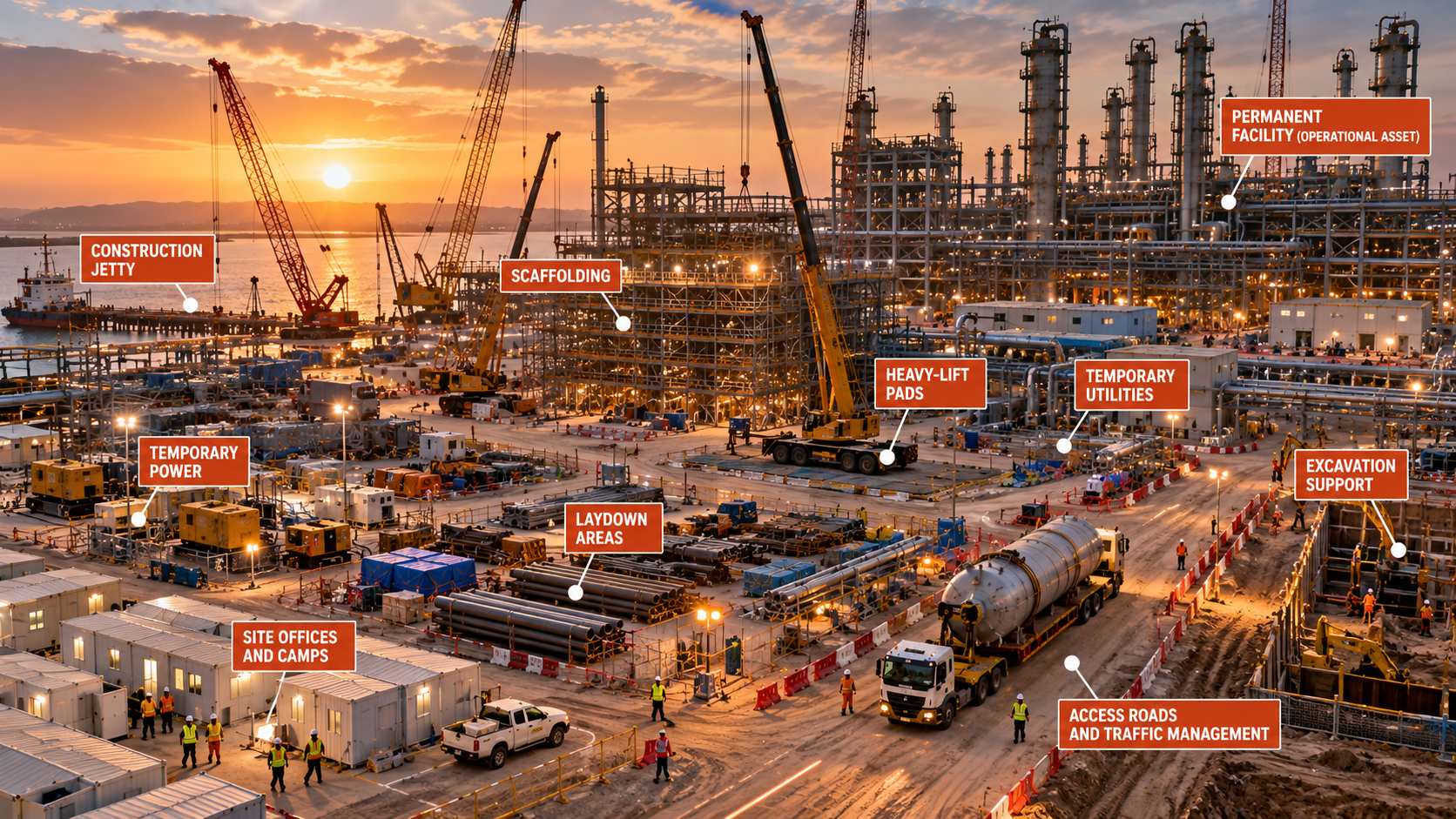
Projects rarely fail because someone forgot that the permanent asset needed foundations, pipe racks, substations, berths, haul roads, or control rooms. Those items are visible. They sit in the scope book, cost estimate, model, procurement plan, and contract strategy.
The trouble often starts with the infrastructure needed to build them.
Access roads. Laydown areas. Scaffolding. Heavy-lift pads. Temporary power. Dewatering. Drainage. Camps. Workshops. Temporary utilities. Site offices. Traffic management. Marine spreads. Bypass systems. Haul routes. Storage compounds. Construction jetties. Welfare facilities.
These are not always glamorous. They usually don't appear in the ribbon-cutting photographs. Many will be removed before operations begin. Yet they shape the job's real productivity.
On complex capital projects, temporary works and construction-enabling infrastructure sit in a dangerous gap. They are essential to execution, but teams often treat them as secondary because they aren't part of the permanent asset. That blind spot can distort schedules, weaken safety, create claims, and force construction teams into expensive workarounds.
Good temporary works planning is not a site detail to be solved later. It is a core part of project planning, constructability, risk management, and commercial control.
Temporary Works Are Not Temporary In Their Impact
The word “temporary” creates a planning bias. It suggests short duration, low consequence, and local control. In reality, temporary works often have a permanent effect on cost, schedule, safety, and asset quality.
A poorly located laydown area can force double handling of major equipment. A missing access road can delay piling, steel erection, cabling, or commissioning. Inadequate temporary power can slow testing and preservation. Weak drainage can damage work fronts before the permanent drainage system is complete. A congested modular yard can disrupt fabrication, inspection, coating, and loadout.
Temporary works also include engineered systems that carry real risk:
Scaffold platforms and falsework
Excavation support and shoring
Temporary bridges and working platforms
Crane mats and lifting pads
Temporary pipe supports
Bypass lines and isolations
Cofferdams and dewatering systems
Temporary marine moorings, ramps, and jetties
Temporary electrical distribution and lighting
Regulators and engineering institutions have long recognized that temporary works can be safety-critical. Guidance from bodies such as the Institution of Civil Engineers, the UK Health and Safety Executive, and engineering standards such as BS 5975 has shaped mature approaches to temporary works control, coordination, design checking, and supervision. The exact regulatory framework varies by jurisdiction, but the principle travels well across oil and gas, energy, mining, infrastructure, and heavy industrial work.
Project management bodies point in the same direction. PMI and APM guidance consistently emphasizes early risk identification, interface management, and realistic planning. ISO 21502 frames project management around integrated planning and control. ISO 45001 reinforces the need to manage work-related hazards through planned systems, not informal improvisation. AACE International’s cost and schedule practices also support the basic point: scope that is poorly defined early tends to appear later as contingency drawdown, change, delay, or dispute.
Temporary works sit at the intersection of all these disciplines. They are scope, risk, method, interface, cost, and schedule all at once.
Why Early Project Planning Often Underestimates Enabling Infrastructure
Most early project teams know temporary works matter. The weakness is rarely ignorance. It is structure.
FEED teams often focus on defining the permanent facility to support approvals, estimates, long-lead procurement, and investment decisions. That is understandable. But when the same planning logic treats construction-enabling infrastructure as a contractor means-and-methods issue, the project can lock in physical constraints before the construction plan is mature.
Several patterns are common.
The Permanent Asset Dominates The Model
Engineering models usually represent the operating facility. They show equipment, pipe racks, cable routes, roads, buildings, drainage, and permanent utilities. Temporary elements may sit outside the model or appear as markups, assumptions, or notes.
That creates a false sense of space.
A plot plan may look acceptable until the team overlays scaffold footprints, crane tailswings, module transport routes, material storage, exclusion zones, emergency access, welding habitats, hydrotest packs, temporary generators, compressors, lighting towers, welfare units, and inspection hold areas.
In brownfield work, the available space is often tighter. Operations may require live access. Hazardous areas may restrict hot work. Existing underground services may limit crane outrigger positions. A turnaround or shutdown can compress hundreds of activities into a short window. When temporary works are not visible early, they become visible at the worst possible time.
Temporary Scope Is Split Across Too Many Owners
Temporary works rarely belong neatly to one team.
Engineering may own design assumptions. Construction may own methods. HSE may own access and welfare standards. Procurement may own camps and site services. Logistics may own marine spreads or abnormal load routes. Contracts may place obligations on EPC contractors or subcontractors. The client may control land, permits, and interfaces with operations or authorities.
When ownership is fragmented, gaps develop. Each team assumes another party has allowed for the enabling work.
For example, a contractor may price a heavy lift based on the availability of a crane pad. The civil package may not include that pad because it is “temporary.” The site preparation package may exclude it because the lift contractor has not been appointed. The lifting plan then arrives late, when the project discovers that soil improvement, underground service protection, or permits are needed before the crane can mobilize.
That is not a crane problem. It is an integration problem.
Commercial Models Push The Issue Downstream
Contract language often allocates temporary works to the contractor. That can be appropriate. Contractors bring method knowledge, specialist suppliers, and practical construction experience.
The mistake is assuming that contractual allocation equals project readiness.
Many temporary requirements depend on earlier decisions that the contractor cannot fully control:
Land acquisition and right-of-way limits
Plot layout and access geometry
Port, road, and marine route approvals
Traffic restrictions and abnormal load permits
Environmental consents for drainage, dewatering, noise, or camp facilities
Interfaces with operating assets
Temporary power source capacity
Geotechnical information for crane pads and haul roads
Sequence of permanent works availability
Early procurement of modular units, transformers, generators, pumps, tanks, or camp systems
If those enabling conditions are not planned early, the contractor inherits constraints rather than choices. The result is predictable: claims, delay notices, reduced productivity, and pressure to accept unsafe or inefficient workarounds.
How The Blind Spot Develops Across The Project Life Cycle
Temporary works risks do not appear suddenly during construction. They mature quietly through each phase.
FEED Sets The Physical Boundaries
FEED decisions often fix the project’s physical envelope. Land take, plot orientation, access points, marine interfaces, battery limits, and major construction sequencing assumptions are shaped well before contractors mobilize.
If the FEED stage does not test construction logistics, the project may carry hidden constraints into sanction. Common misses include:
Not enough room for laydown and preassembly
Access roads that cannot support construction traffic
No clear route for oversized equipment
Poor separation between construction traffic and live operations
Insufficient space for camps, workshops, and welfare
Drainage assumptions that ignore early earthworks conditions
Underdeveloped marine or port support plans
Late recognition of dewatering needs
Construction Industry Institute research and industry constructability guidance have long promoted early construction input because design and execution choices are cheaper to influence before they harden. Temporary works are one of the clearest reasons that constructability reviews need to happen early, not just before mobilization.
Detailed Engineering Can Close Options Without Noticing
During detailed engineering, the permanent design becomes more precise. Underground networks, roads, foundations, cable trenches, buildings, drainage systems, and pipe corridors become fixed.
This is also when temporary works can lose space.
A route that looked open at FEED may become blocked by underground services. A crane location may clash with a new utility corridor. A haul route may cross early permanent works that cannot take axle loads. A preassembly area may disappear because a building package starts earlier than expected.
If temporary works aren't part of model reviews, 4D planning, and constructability checks, the design may look complete but still be hard to build.
Procurement Decisions Affect Temporary Capacity
Major procurement is not limited to the permanent asset. Temporary facilities also have market lead times, transport constraints, and specialist supply chains.
Construction camps require utilities, sewage treatment, water supply, catering, medical support, security, and permitting. Temporary power may need generators, substations, transformers, distribution boards, cabling, grounding, and maintenance support. Marine logistics may need barges, tugs, landing craft, fenders, moorings, temporary ramps, or dredging support.
When these requirements are treated as small site services, procurement is delayed. That can leave the project with limited options, higher prices, or equipment that doesn't match real demand.
A commissioning team may discover that temporary power is insufficient for simultaneous testing. A pipeline spread may wait on temporary bridges or access mats. A shutdown team may find that specialist scaffolding and encapsulation are not available in the required window.
These are as much a commercial risk as a planning risk.
Mobilization Exposes The Assumptions
Mobilization is where optimistic planning meets physical reality.
Late requests for temporary facilities indicate the project has not defined its enabling infrastructure. Teams start asking for extra offices, tool stores, workshops, lighting, generators, access gates, parking, medical posts, security fencing, temporary drainage, and laydown space.
Repeated site layout changes often follow. The camp needs power. The power generators need fuel access. Fuel access conflicts with heavy haul routes. The haul routes cross pedestrian walkways. The pedestrian walkways interfere with crane swing radii. The team moves a storage area, then moves it again because another subcontractor needs the same space.
At this stage, every change costs money. More seriously, the site can normalize improvisation. That is when temporary solutions become uncontrolled.
Construction Turns Gaps Into Lost Productivity
During peak construction, weak temporary works planning shows up as friction at the work front.
Crews wait for scaffold access. Cranes wait for clear lift paths. Materials arrive before storage is ready. Subcontractors compete for the same laydown zone. Temporary lighting is inadequate for night work. Dewatering pumps lack discharge approvals. Roads degrade under heavy traffic. Welders lose time walking to distant welfare points. Commissioning teams cannot energize systems because temporary power distribution is incomplete.
No single event may look catastrophic. The damage comes through cumulative delay and reduced labor productivity.
AACE International and RICS both emphasize the importance of clear scope, change control, productivity, and records in managing cost and claims. Temporary works gaps create exactly the conditions that make disputes hard to avoid: unclear responsibility, late instruction, disrupted sequence, and weak baseline assumptions.
Commissioning Needs Temporary Systems Too
Commissioning is often treated as the phase when temporary works reduce. In many projects, the opposite happens.
Temporary power, water, air, nitrogen, steam, flushing systems, chemical cleaning systems, test blinds, bypasses, temporary controls, lighting, access platforms, preservation systems, and vendor facilities may all increase in importance.
A plant may be mechanically complete but not testable because temporary utilities cannot support the commissioning sequence. Offshore, temporary generation or accommodation constraints can limit simultaneous activities. In infrastructure, traffic staging and temporary diversions may remain critical until final tie-ins are complete. In brownfield work, commissioning can depend on temporary isolations and bypass arrangements that require operations approval well in advance.
Handover can also suffer. Temporary works that were never clearly tracked may remain in place. Temporary drainage becomes semi-permanent. Temporary access tracks are left for operations to inherit. Temporary supports or cable routings require late removal. The project then spends closeout time resolving items that should have been controlled from the start.
The Consequences Are Predictable And Expensive
Weak temporary works planning rarely creates one clean failure mode. It creates a web of constraints.
Congestion And Unsafe Access
Congestion is one of the first visible symptoms. People, plant, materials, waste, and vehicles compete for the same limited space.
Congested work fronts create safety exposure. Pedestrian and vehicle segregation becomes harder. Emergency access may be compromised. Lifting exclusion zones overlap with scaffold access routes. Temporary storage creeps into walkways. Housekeeping declines because there is nowhere practical to place materials.
Safety regulators and industry bodies consistently emphasize planning, access control, lifting control, and traffic management because these are recurring sources of serious incidents. Temporary works planning is one practical way to turn those principles into site reality.
Rework And Sequence Disruption
When temporary infrastructure is missing, teams often build workaround solutions. Some are harmless. Others trigger rework.
Teams may build an access road, then cut it open for uncoordinated underground services. Teams may relocate a laydown area. You can't solve all of these after materials have already been cataloged and stored. A scaffold may be erected before adjacent heavy lifts, then modified or removed. You may have to install temporary drainage twice because permanent drainage wasn't available when assumed.
Poor sequencing can also damage completed work. Heavy construction traffic may cross finished paving. Temporary supports may interfere with coatings or insulation. Late dewatering can undermine excavation plans. A lack of preservation facilities can harm sensitive equipment before installation.
Lifting Conflicts And Idle Resources
Heavy-lift planning often reveals the true maturity of site planning.
A lift depends on ground bearing capacity, crane access, mat design, underground service protection, exclusion zones, adjacent work fronts, rigging studies, wind limits, transport routes, permits, and emergency arrangements. You can't solve all of these on the day.
If the lift area isn't ready, expensive resources sit idle. Cranes, riggers, transport equipment, vendor specialists, inspectors, and installation crews can all become idle. On offshore and marine projects, waiting costs can rise quickly because vessels, weather windows, port slots, and tide constraints add pressure.
Logistics Delays And Double Handling
Logistics plans often assume materials flow smoothly from supplier to port, port to site, laydown to work front, and installation to completion. Temporary infrastructure decides whether that flow is realistic.
Insufficient storage leads to off-site warehousing, double handling, and poor material control. Inadequate roads slow deliveries. Poor traffic staging delays public interfaces on infrastructure work. Limited marine support can leave modules waiting at fabrication yards or ports.
For EPC projects, this can distort contractor performance. The contractor may appear inefficient when the real issue is that the project environment does not allow efficient production.
Claims And Strained Commercial Relationships
Temporary works ambiguity is fertile ground for claims.
A contractor may argue that the client failed to provide access, land, permits, utilities, or interface conditions. The client may argue that the contractor accepted responsibility for temporary works. Subcontractors may claim disruption because work fronts were unavailable or site logistics changed repeatedly.
The argument often turns on records, contract wording, baseline assumptions, and notices. But behind the paperwork lies a practical failure: the project didn't define what construction needed to succeed.
The Controls That Make Temporary Works Visible
Temporary works planning improves when it becomes visible, owned, and reviewed with the same discipline as permanent scope. The controls do not need to be bureaucratic. They need to be timely.
Build A Temporary Works Register Early
Start a temporary works register in FEED and mature it through detailed design and construction planning. It should capture both engineered temporary works and enabling facilities.
Useful fields include:
Register field | Why it matters |
Temporary works item | Defines what must exist before work can proceed |
Purpose and work package | Links the item to execution sequence |
Location and footprint | Makes space demand visible on the plot plan |
Design or engineering need | Identifies calculations, checks, and approvals |
Owner and approver | Reduces gaps between client, EPC, contractors, and specialists |
Required-by date | Connects the item to the schedule |
Permits and authority approvals | Highlights external constraints |
Removal or handover plan | Prevents temporary items becoming unmanaged legacy assets |
This register should not sit in isolation. It should link to the risk register, schedule, cost estimate, procurement plan, constructability reviews, and site readiness process.
Develop An Enabling Works Strategy
An enabling works strategy answers a simple question: what must be in place before construction can proceed safely and efficiently?
It should address:
Site access and security
Earthworks, grading, drainage, and dewatering
Early utilities and temporary power
Construction water and wastewater
Welfare, medical, and emergency response facilities
Camps and accommodation where relevant
Laydown, warehousing, preservation, and workshops
Traffic management and haul routes
Marine, port, rail, or aviation interfaces
Temporary telecoms and site IT where required
Waste management and hazardous material storage
Interface with operations in brownfield environments
For projects in the Gulf region, remote industrial zones, desert conditions, port interfaces, heat stress management, large expatriate workforces, and long logistics chains can make enabling infrastructure especially important. Welfare, water, power, shaded rest areas, transport, dust control, medical capability, and camp logistics are not peripheral issues. They directly affect safe production.
Use Construction Logistics Plans As Control Documents
A construction logistics plan should be more than a drawing with arrows. It should define how the site will work over time.
Good logistics plans show phased access, storage, haul roads, pedestrian routes, crane zones, delivery gates, security checkpoints, waste routes, emergency access, temporary utilities, and congestion points. Update them as the sequence changes.
For brownfield work, the plan must integrate with live operations. For marine projects, it must address berth windows, temporary moorings, loadout sequencing, weather exposure, and vessel interactions. For infrastructure, it must include public traffic staging, road closures, utility diversions, and community impacts.
4D planning can help when used practically. The goal is not a polished animation. The goal is to reveal clashes between time, space, and method before crews find them in the field.
Forecast Temporary Utility Demand
Temporary utilities are often underestimated because each package estimates its own need. The project then discovers the combined demand too late.
A temporary utility demand forecast should cover construction and commissioning phases separately. It should include:
Power load profiles by phase
Water demand for construction, testing, welfare, camps, and dust suppression
Compressed air, nitrogen, steam, or inerting needs
Lighting, heat, cooling, and ventilation loads
Fuel logistics and storage
Wastewater and sewage treatment capacity
Backup and redundancy needs for critical activities
Commissioning can create peak demand that construction planners miss. Hydrotesting, flushing, preservation, loop checks, energization, and vendor testing may require temporary systems before permanent utilities are available or accepted.
Make Laydown Planning A Production Issue
Laydown space is productive capacity. Treating it as spare land is a mistake.
A practical laydown plan should identify material categories, storage conditions, preservation needs, inspection areas, quarantine zones, lifting access, fire separation, weather protection, security needs, and turnover requirements. It should also define how space will be released over time.
For modular EPC work, laydown and preassembly planning can shape the entire sequence. For shutdowns, the ability to stage spares, tools, scaffold material, valves, blinds, and waste containers before the outage can decide whether the critical path is achievable.
Leading Indicators That The Blind Spot Is Active
Temporary works problems announce themselves early if leadership knows what to look for.
Common leading indicators include:
Late requests for offices, workshops, welfare units, generators, pumps, lighting, or storage
Repeated changes to site layout drawings after mobilization
Laydown areas filling before peak construction begins
Materials stored outside planned zones
Incomplete access roads or haul routes when work packages are released
Temporary power shortages or frequent generator additions
Dewatering and drainage solutions designed reactively
Crane locations changing because of underground clashes or congestion
Scaffold requests growing faster than planned productivity
Work fronts opened before access, lighting, or lifting arrangements are ready
Contractors using informal storage, parking, or maintenance areas
Marine or port support plans lagging module delivery schedules
Shutdown teams relying on last-minute staging plans
Temporary items left in place without removal ownership
These indicators are not minor irritations. They show that the project is consuming contingency, space, and goodwill before the main work has fully started.
Senior leaders should treat them as early warnings, not site noise.
The Questions Leaders Should Ask Before Major Site Activity Begins
Project directors, engineering managers, construction managers, and senior leaders do not need to design every temporary work. They do need to test whether the project has created the conditions for safe and productive work.
The following questions are useful before mobilization, major civil works, mechanical erection, shutdown execution, offshore campaigns, commissioning, and handover.
Questions For Project Directors
Has the project defined the enabling infrastructure needed to deliver the approved schedule?
Are temporary works and construction facilities included in the cost estimate, contract strategy, and risk register?
Which temporary works depend on client-controlled land, permits, utilities, or interfaces?
Does the commercial model align responsibility with control?
What assumptions about access, laydown, camps, marine support, and utilities sit behind contractor productivity rates?
Are temporary works risks visible in change control and executive reporting?
Questions For Engineering Managers
Has the permanent layout been tested against construction access, lifting, laydown, and temporary utility needs?
Have underground services been checked against crane pads, haul routes, excavations, and temporary foundations?
Are temporary works requirements captured in design reviews and model reviews?
Are there early design decisions that could preserve construction flexibility at low cost?
Have brownfield operating constraints been built into the construction plan?
Questions For Construction Managers
Is there a phased construction logistics plan that matches the schedule?
Are access, lighting, welfare, lifting, scaffold, drainage, and temporary power ready before work fronts open?
Do subcontractors understand space allocation and traffic rules?
Are laydown areas sized and controlled for peak demand?
Which workarounds are being used repeatedly, and what do they reveal?
Questions For Commissioning And Handover Leaders
What temporary utilities are needed for pre-commissioning and commissioning?
Are temporary systems designed, inspected, maintained, and removed under clear ownership?
Could temporary bypasses, supports, cables, or access arrangements affect final acceptance?
Which temporary works must remain during early operations, and who accepts them?
Are removal, reinstatement, and closeout activities planned and costed?
These questions are not theoretical. They protect schedule logic, contractor performance, and safety leadership.
How To Make Temporary Works Part Of Normal Project Control
The fix is not to create a parallel bureaucracy. The fix is to integrate temporary works into existing project controls.
Start with the execution strategy. If the project depends on modularization, marine delivery, remote camps, brownfield tie-ins, heavy lifts, shutdown windows, or phased public traffic management, the enabling infrastructure should appear in the strategy.
Then connect the controls:
Control | Practical use |
Temporary works register | Makes scope, owners, dates, and approvals visible |
Responsibility matrix | Clarifies who designs, provides, inspects, maintains, and removes each item |
Constructability reviews | Tests whether the permanent design can be built safely and efficiently |
Access studies | Confirms people, plant, materials, and emergency routes |
Lifting plans | Align crane locations, ground conditions, exclusion zones, and sequence |
Temporary utility forecasts | Prevents shortages during construction and commissioning |
Laydown plans | Controls material flow, preservation, and work-front supply |
Readiness reviews | Confirms enabling conditions before releasing field activities |
Interface management | Connects client, EPC, contractors, operations, logistics, and authorities |
Readiness reviews are especially valuable. Before a major work package starts, the review should confirm that the physical and administrative conditions are in place. That includes permits, access, scaffold, lifting, materials, temporary utilities, welfare, drainage, drawings, inspections, emergency arrangements, and interface approvals.
If these conditions are not ready, the schedule should not pretend the activity can proceed at full productivity.
Realistic Examples From Complex Projects
Consider a brownfield refinery revamp. The tie-in window is fixed. The permanent design is sound. Long-lead valves arrive on time. Yet the job loses time because scaffold material is staged too far from the units, night lighting is insufficient, and temporary access conflicts with operations routes. The issue is not engineering quality. It is weak construction-enabling planning.
On an offshore campaign, bed space and deck space can limit productivity as much as craft labor. Temporary power, habitat systems, lifting windows, marine logistics, and weather constraints decide how much work can happen at once. Treating these as contractor details ignores the fact that platform access, simultaneous operations, and vessel availability require early integration with the operator.
On a rail or highway project, traffic diversions, temporary drainage, utility protection, haul roads, and public access can dominate the sequence. A permanent bridge design may be complete, but the job stalls if temporary works approvals, road closures, or staging areas are late.
On a remote mining project, construction camps, water supply, fuel storage, workshops, access roads, communications, and medical facilities aren't overhead. They are the production system. If they lag, equipment and labor arrive before the site can use them.
On a marine terminal project, temporary jetties, dredging support, mooring arrangements, crane pads, and module transport routes can determine whether the project meets a seasonal or port-window constraint. You can't solve the marine spread with a late drawing revision.
The pattern is consistent across sectors. Temporary works are where strategy becomes buildable work.
The Professional Takeaway
Temporary works do not deserve attention because they are complicated. They deserve attention because they enable the work.
They shape how labor moves, how materials flow, how cranes operate, how contractors perform, how safely people access work fronts, and how commissioning proves the asset. They affect land, layout, permits, procurement, logistics, design, contracts, and interfaces long before the first major crew arrives.
Projects that manage this well don't wait for the construction contractor to solve everything under pressure. They make temporary works visible in FEED, test them during detailed engineering, procure critical facilities early, review readiness before mobilization, and control removal at handover.
Temporary works may not be part of the permanent asset, but they are part of the permanent outcome. Plan them as core execution infrastructure, not as an afterthought.


