


Automation Bias in Project Management: When AI Stops Being Questioned
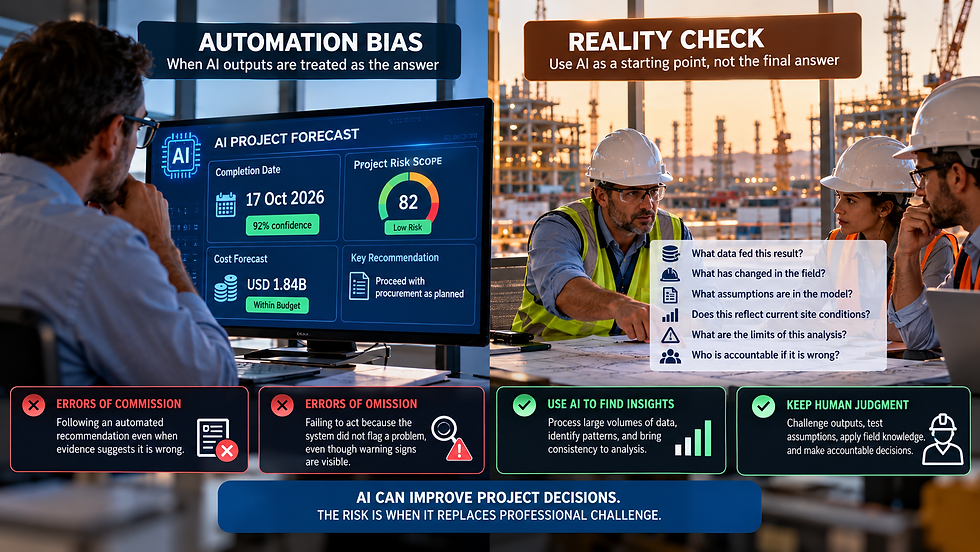
A forecast that says a project will finish on 17 October 2026 feels more convincing than a planner saying, “late Q4, if the module yard recovers productivity.” A dashboard risk score of 82 looks more authoritative than a construction manager’s caution that access constraints are worse than the model assumes. A contract tool that flags a clause as “low risk” can quickly become the answer, rather than a starting point for review.
That is the practical problem with automation bias in project management. When software or AI outputs look precise, technical, and data-driven, teams may stop asking basic project questions: What data fed this result? What changed in the field? What assumptions sit behind the model? Who is accountable if the recommendation is wrong?
This matters most on complex capital projects, where a weak forecast can move procurement strategy, contractor claims posture, cash flow planning, contingency drawdown, safety focus, commissioning readiness, and executive reporting. Oil and gas, EPC, construction, mining, utilities, transport, marine, and energy projects all depend on judgment under uncertainty. Automation can help that judgment. It can also make poor assumptions travel faster.
Automation Bias Is Not A Technology Problem Alone
Automation bias is a well-recognized human-factors issue. Research on automation in aviation, healthcare, process control, and high-risk operations shows that people can overtrust automated aids, miss contradictory evidence, or become less active in monitoring when a system appears competent. Human-factors scholars such as Raja Parasuraman, Lisanne Bainbridge, and Mica Endsley are often cited in discussions of automation, complacency, and situational awareness.
Project management faces the same risk.
A project team may accept an AI-generated completion forecast because it integrates thousands of schedule activities, progress updates, and productivity signals. A procurement group may rely on an automated vendor score because it combines price, delivery, safety, and quality history. A risk committee may accept a heat map because the scoring model appears consistent across the portfolio.
The danger is not that these tools are useless. Many are valuable. They can find patterns no person would see, process large volumes of data, and bring consistency to repetitive analysis. The danger appears when the technology replaces professional challenge.
Automation bias often shows up in two forms:
Errors of commission The team follows an automated recommendation even when field evidence, contract context, or engineering judgment suggests it is wrong.
Errors of omission The team fails to act because the system did not flag a problem, even though warning signs are visible elsewhere.
Both can occur quietly. No one announces, “We are surrendering judgment to the tool.” Instead, the review rhythm changes. Questions become thinner. Exceptions get treated as noise. Experienced people learn that challenging the model slows the meeting down.
In capital projects, that shift can be expensive.
Project controls teams may report a confidence level that is not supported by schedule logic. Cost engineers may accept a forecast that carries forward poor coding or late accruals. Risk managers may allow a scoring engine to push familiar risks to the top while weak signals stay hidden. Procurement teams may rely on vendor scores that miss current capacity constraints. Contract reviewers may accept clause summaries without testing them against jurisdiction, governing law, amendments, and project-specific risk allocation.
AI has made this issue more visible, but automation bias is not new. Primavera schedules, Monte Carlo tools, earned value dashboards, cost systems, document review platforms, procurement systems, and safety analytics have shaped decision-making for years. The difference now is scale, speed, and persuasiveness. Generative AI and advanced analytics can present recommendations with confidence, create convincing narratives, and produce precise-looking outputs even when the underlying evidence is thin.
That makes governance more important, not less.
Where Automated Recommendations Can Distort Project Decisions
Automation bias can affect almost every project function. The common thread is simple: a tool converts uncertain, incomplete, or judgment-heavy information into a clean output, and the organization begins treating that output as more certain than it is.
Project Controls And Completion Forecasting
AI-generated completion forecasts are attractive because they can combine schedule progress, quantities, production rates, past trends, constraints, and resource data. In a large EPC project, that can be far better than manual spreadsheet forecasting.
But forecasts can mislead when the model depends on weak inputs.
For example, a completion forecast may assume that reported percent complete is reliable. If progress measurement varies by contractor, work package, or discipline, the forecast may reward optimistic reporting. If the tool uses past productivity to forecast future performance, it may miss a coming shift from open-area installation to congested tie-ins. If schedule logic is poor, the model may calculate dates from relationships that no longer reflect how work will actually be executed.
A precise completion date is not the same as a reliable completion date.
Good project controls still need schedule health checks, logic review, critical path validation, float analysis, progress measurement discipline, and field verification. AACE International guidance on cost and schedule estimating emphasizes basis, maturity, classification, and uncertainty. Those ideas become even more important when forecasts are automated.
Cost Forecasting And Contingency
Cost prediction tools can compare current commitments, trends, quantities, productivity, change logs, and historical benchmarks. They can support earlier warnings on overruns. They can also produce false confidence if the cost structure is poorly coded or if commercial events are missing.
A model may forecast a final cost below budget because invoices lag actual work. It may understate risk exposure because potential claims have not been entered. It may treat contingency drawdown as linear when risk burn-down depends on specific milestones. It may learn from historical projects that look similar in category but differ in contracting strategy, local labor market, import restrictions, marine logistics, or regulatory exposure.
Cost forecasts are commercial instruments, not just technical outputs. They affect funding requests, board reporting, lender communication, contractor negotiation, and contingency governance. That means they need clear assumptions and accountable ownership.
Risk Management And Automated Rankings
Risk tools often rank threats using probability, impact, proximity, detectability, or other scoring factors. AI may add text analysis, lessons learned, weather patterns, supplier data, and claims history. This can improve consistency across a portfolio.
The weakness is that scoring can create authority without insight.
Risk scores are only as good as the framing behind them. A model may push frequent, familiar risks to the top because similar language appears in many registers. It may under-rank low-frequency, high-impact events because historical data is sparse. It may miss interface risks that sit between packages, such as power availability for commissioning, temporary utilities, SIMOPS restrictions, late vendor data, or incomplete as-built documentation.
ISO 31000 frames risk management around uncertainty, context, stakeholder needs, and continual review. Automated ranking can support that work, but it cannot replace the conversation about what has changed and what the project does not yet know.
Procurement, Vendor Scoring, And Supply Chain Decisions
Automated vendor scoring can help compare suppliers across delivery history, quality records, safety performance, financial strength, technical compliance, price, and responsiveness. Used well, it gives procurement teams a structured view.
Used poorly, it can hide serious project risk.
A vendor score may rely on historical performance from a supplier’s previous facility, while the current order depends on a different plant or subcontractor. It may underweight current order book congestion. It may miss export-control issues, port delays, customs constraints, or raw-material availability. It may treat a low bid as favorable even when the commercial team knows the vendor has aggressively priced exclusions.
Procurement recommendations also tend to carry a halo effect. Once a vendor shows up in green on a dashboard, challenging it becomes harder. Teams may stop asking whether the score reflects the actual package, location, schedule pressure, contract terms, inspection regime, and expediting burden.
Contract Analysis And Claims Posture
AI contract review tools can summarize clauses, compare drafts, flag deviations, and identify missing provisions. That is useful for high-volume review.
Risk appears when summaries replace legal and commercial interpretation.
A tool may classify a liquidated damages clause as “standard” without understanding the cap, carve-outs, governing law, notice regime, extension of time process, or interaction with other amendments. It may recommend acceptance of a limitation clause that conflicts with project insurance assumptions. It may miss how a change order provision works under a specific contract form once correspondence practice and course of dealing are considered.
Contract analysis requires context. Clause recognition is not the same as commercial judgment.
Design Review, Quality, And Safety Analytics
Automated design checks can identify clashes, missing tags, inconsistent data, dimensional issues, or deviations from rules embedded in a model. Quality analytics can find recurring nonconformance patterns. Safety systems can flag leading indicators from observations, permits, incidents, and near misses.
These tools can improve attention. They can also redirect attention too narrowly.
If a safety analytics model ranks dropped objects as the top risk because reporting is strong in that category, the project may miss a poorly reported confined-space issue. If a quality tool flags weld defects based on historic patterns, inspectors may focus there and miss coating risks caused by weather or storage. If design review automation checks what is easy to code, it may miss constructability, operability, maintainability, temporary works, access, and human factors.
Professional engineering institutions and regulators have long stressed competence, accountability, and duty of care. Automated checks do not reduce those obligations. They change how evidence is gathered and challenged.
Stakeholders, Commissioning, And Operational Readiness
Stakeholder sentiment tools, permit trackers, readiness dashboards, and commissioning completion engines can all help leaders see complexity. Yet they may oversimplify reality.
Operational readiness is especially vulnerable because it depends on many forms of evidence: procedures, spares, training, handover packs, isolation plans, permits, vendor support, punch lists, systemization, performance testing, and owner acceptance. A dashboard may show high readiness because documents are uploaded and checklists are closed. The operations team may still know crews haven't practiced abnormal scenarios or that they don't trust vendor data.
The system can confirm process completion. It cannot always confirm readiness.
Why Precise Outputs Can Create False Confidence
Automation bias thrives when output precision is confused with input quality.
A model can calculate to several decimal places from assumptions that no experienced estimator would accept without challenge. A scheduling tool can assign a finish date based on logic never built for predictive use. A generative AI assistant can write a confident contract recommendation from missing attachments. A vendor model can rank suppliers using stale data. A safety dashboard can classify risks based on what people report, not what is actually happening.
The output may look clean because the system has forced messy project reality into structured data.
Several factors increase false confidence.
Data gaps get hidden.
Projects often have missing, late, inconsistent, or politically shaped data. Progress may be reported differently across contractors. Cost accruals may lag. Procurement status may be updated manually and unevenly. Risk registers may contain duplicated or stale entries. When a tool ingests this data, the gaps may disappear behind a single score.
Historical data may not match the present project.
Benchmarking is valuable, but projects are not laboratory repeats. An LNG project, offshore wind farm, rail system, mine expansion, port upgrade, or power transmission program can differ by geography, contracting model, regulatory setting, labor market, modularization strategy, owner capability, and supply chain pressure. Historical similarity needs testing.
Model logic may be opaque.
Some tools can explain the main factors behind a recommendation. Others cannot. If a team cannot understand why a model increased the risk rating of one package or changed a forecast date, the review becomes weaker. NIST’s AI Risk Management Framework emphasizes characteristics such as validity, reliability, transparency, accountability, and human oversight. Those principles are highly relevant to project delivery.
Dashboards compress uncertainty.
A red, amber, or green score is easy to read. It is also easy to overread. It can hide confidence levels, data quality, expert disagreement, changing assumptions, and the range of possible outcomes. For senior reporting, simplification helps. For decision-making, oversimplification can be dangerous.
Automation can scale bias.
If an estimating model was trained on past projects that systematically under-recorded indirect costs, it may repeat that underestimation. If vendor evaluation data reflects historic preference for certain suppliers, automated scoring may reinforce that preference. If historical schedules excluded late engineering rework, a forecasting tool may understate engineering risk. Technology does not remove bias by default. It can industrialize it.
This is why we need to challenge the assumption that automated analysis is inherently more reliable than professional judgment. Human judgment can be flawed, political, and inconsistent. So can automated judgment. The better question is how to combine them in a controlled way.
PMI, APM, ISO, AACE International, CII, NIST, regulators, and engineering bodies all point, in different language, toward the same practical principles: define the basis of decision-making, understand uncertainty, maintain competence, use fit-for-purpose methods, record assumptions, review performance, and keep accountability clear.
That is the standard project leaders should apply to AI and analytics.
Controls That Keep Automation Useful And Questioned
The aim is not to slow projects down with bureaucracy. The aim is to make automated recommendations decision-grade. A major capital project does not need every output to go through a committee. It does need clear rules for when automation can inform, when it can recommend, and when it must be independently challenged.
Set Clear Decision Rights
Every automated recommendation should have an owner. Not just a system owner, but a decision owner.
If an AI forecasting tool predicts mechanical completion in March, who accepts that forecast for reporting? If a procurement engine recommends a supplier, who signs off that the recommendation reflects package risk? If a contract tool classifies a liability clause as acceptable, who confirms the commercial position?
Accountability should sit with a competent person or governance body, not with the software. The language matters. “The model approved it” shouldn't be acceptable on a project with safety, financial, legal, or public obligations.
Use Human-in-the-loop Review With Real Authority
Human-in-the-loop review is often mentioned in AI governance, but it can become theater. A reviewer who lacks time, competence, access to evidence, or authority is not a control. They are a rubber stamp.
Effective review needs:
Access to the source data and assumptions behind the recommendation
Clear criteria for acceptance, challenge, or escalation
Time to examine exceptions before deadlines force approval
Authority to override the tool and require further analysis
A record of why the automated output was accepted or rejected
Reviewers should not be asked only, “Do you approve?” Ask, “What evidence would make this recommendation wrong?”
Define Challenge Thresholds
Projects should set thresholds that trigger independent review. Governance procedures can build these in.
Examples include:
A completion forecast moves by more than an agreed number of days in one reporting period
A cost forecast changes materially without a matching change in scope, productivity, or commercial exposure
A risk score changes category without a clear explanation
A vendor recommendation conflicts with technical evaluation concerns
A contract tool rates a clause low risk where liability, delay, indemnity, termination, warranty, or change control is involved
A safety analytics tool shows a major improvement while leadership observations suggest weaker field discipline
Thresholds prevent quiet drift. They give teams permission to challenge without appearing obstructive.
Test Sensitivity And Ranges, Not Just Point Estimates
Point estimates are seductive. Ranges are more honest.
A completion forecast should show sensitivity to productivity, access, engineering release, module delivery, weather, commissioning constraints, and rework. A cost forecast should show confidence ranges, key drivers, and exposure to claims, foreign exchange, logistics, escalation, and quantity growth where relevant. A vendor recommendation should test what happens if you weight delivery performance, inspection failure, or expediting costs differently.
Monte Carlo methods, scenario planning, and estimate classification are not new. AI does not replace them. In many cases, it makes them more necessary because the tool may hide uncertainty unless the project asks for it.
Compare Predictions Against Actual Outcomes
An untested model becomes a belief system.
Projects should track forecast accuracy over time. Did the AI completion forecast predict slippage earlier than the project team? Did the automated risk rankings correlate with realized issues? Did vendor scores predict field performance, NCRs, delivery delays, and claims? Did safety analytics identify real exposure or mainly reflect reporting culture?
This does not require academic perfection. It requires disciplined learning. If the tool is predictably wrong, recalibrate it or change how you use it.
Check Source Data Before Debating Outputs
Many model disputes are really data disputes.
Before senior leaders debate why the forecast has changed, someone should confirm whether progress data, schedule updates, procurement dates, quantities, inspection results, cost accruals, and change logs are current and consistent. Data quality checks should be part of the reporting calendar, not an emergency exercise after a bad surprise.
Useful checks include:
Completeness of key fields
Date freshness
Coding consistency across WBS, CBS, contracts, and systems
Duplicate or stale risks
Manual overrides and unexplained changes
Alignment between field records and system status
Treatment of missing data
Bad data governance is not a clerical issue. On a complex project, it becomes a decision risk.
Require Explanation For High-impact Recommendations
Not every tool needs full technical transparency for every output. But high-impact recommendations need enough explanation for a competent reviewer to challenge them.
For example:
Automated output | Minimum explanation needed |
Completion forecast | Main drivers, data cut-off date, schedule basis, assumptions, confidence range |
Cost prediction | Cost elements affected, excluded items, contingency treatment, change and claim assumptions |
Contract recommendation | Clauses reviewed, documents included, jurisdiction assumptions, unresolved exceptions |
Vendor ranking | Criteria weightings, data sources, recent performance inputs, package-specific risks |
Safety risk alert | Data sources, classification logic, reporting limitations, site context |
If the explanation isn't sufficient for a decision, treat the output as a prompt for further review, not a basis for a recommendation.
Monitor Model Performance And Drift
Project conditions change. A model that worked during engineering may perform poorly during construction. A tool calibrated on civil works may not predict commissioning risk. A vendor scoring approach that worked in a stable supply market may degrade when shipping constraints, labor shortages, or geopolitical disruption affect suppliers.
Model monitoring should include performance, data drift, user behavior, overrides, false positives, false negatives, and unintended consequences. NIST’s AI governance work and broader regulatory guidance on automated decision-making both stress ongoing monitoring, not one-time approval.
Protect Professional Skepticism
Cultural control may be the hardest.
Project leaders need to make challenge normal. A planner who questions an AI forecast should not be treated as resisting technology. A contract manager who rejects a tool’s summary should not be seen as slowing the process. A superintendent who says the dashboard does not match the field should be heard early, not after the milestone slips.
Warning signs deserve attention:
Teams accept outputs without asking for assumptions
Review meetings focus on dashboard colors rather than causes
Model recommendations cannot be explained in project language
Human reviewers approve outputs they do not understand
Contrary field evidence is dismissed as anecdotal
Professional judgment declines because “the system would flag it”
Exceptions become administrative noise rather than learning signals
Senior reports show precision without confidence ranges
Once professionals become passive approvers, automation has crossed a line.
The Leadership Task Is To Combine Automation With Responsibility
Project leaders do not need to choose between AI and judgment. The real task is to design decision systems where technology improves the quality, speed, and consistency of analysis while professionals remain accountable for interpretation and action.
That starts with clarity about what each tool can do.
Some tools should inform decisions, such as document search, anomaly detection, schedule health checks, and early warning dashboards. Some may recommend actions, such as reprioritizing risks, adjusting forecasts, or shortlisting vendors. Very few should decide without meaningful human involvement, especially where safety, cost, legal exposure, permit compliance, or operational readiness is at stake.
The higher the consequence, the stronger the controls should be.
Commercial awareness also matters. Automated systems can reduce manual effort and improve early warning, but they can also create hidden liabilities. If a project adopts AI contract review, who validates its outputs? If a forecast is used for lender reporting, what assurance supports it? If vendor scoring affects award decisions, can the owner explain the criteria? If safety analytics direct inspection attention, how does the project guard against blind spots?
These questions are not anti-technology. They are part of mature delivery.
A useful operating model includes a few practical rules:
Use automation to broaden evidence, not narrow it
Demand assumptions, data cut-off dates, and uncertainty ranges
Treat unexplained precision as a risk signal
Keep field observation and professional experience in the loop
Record overrides and learn from them
Compare forecasts with actual outcomes
Assign named accountability for final decisions
Escalate high-impact recommendations through competent review
The best project teams will not be the ones that reject AI. They will be the ones that learn how to distrust it productively.
That means asking better questions. What would have to be true for this recommendation to be right? What evidence points the other way? Which data is missing? How has the model performed before? What changed since the training data or benchmark set was created? Who owns the decision if the output is wrong?
On complex projects, confidence should be earned through evidence, challenge, and learning. A dashboard can support that process. It cannot replace it.
Automation should strengthen project judgment, not replace the obligation to question it. The moment a machine recommendation stops being challenged, it stops being a decision aid and starts becoming an unmanaged project risk.


