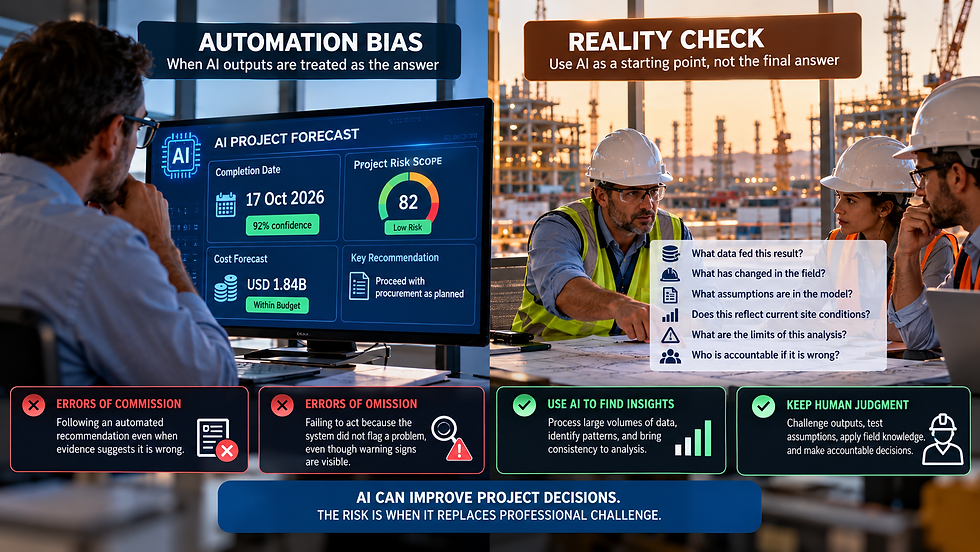
Information Maturity in Project Management Why Not Every Document Is Decision Ready

A project document can be approved, numbered, uploaded, searchable, and still be the wrong basis for a decision.
That is uncomfortable, because complex projects run on documents. Drawings, models, estimates, schedules, geotechnical reports, vendor data, permits, risk registers, constructability reviews, commissioning procedures, and handover records all move through formal systems. They carry revision numbers, workflows, transmittals, review codes, and approval stamps.
The problem is that formal control is not the same as decision readiness.
A civil alignment drawing issued at concept stage may be perfectly adequate for route option screening. The same drawing may be dangerous if used to buy long-lead crossings, negotiate land access, or set a construction sequence. A vendor layout marked “reviewed” may support interface discussions but still be unsuitable for fabrication. A shutdown schedule may be approved for planning workshops while still resting on access assumptions that operations has not confirmed.
This is where information maturity in project management matters. Mature project teams classify information by its maturity, verification, confidence, and fitness for purpose. They do not treat every controlled document in a common data environment as equally reliable.
That distinction is not academic. It affects cost commitments, procurement, safety, design integrity, claims, commissioning, and operational readiness. In capital projects, weak information rarely fails politely. It shows up as rework, standing time, late change, disputed scope, unsafe sequencing, missing spares, incomplete systems, and handover records nobody trusts.
Document Control Does Not Equal Information Maturity
Document control answers important questions.
It tells the project which file is current, who issued it, who received it, what revision it carries, and whether it passed through the agreed workflow. On regulated and high-risk projects, that discipline is essential. ISO 19650 provides a recognized framework for managing information over the asset life cycle, including common data environments and information requirements. Project management bodies such as PMI and APM also stress the need for governance, configuration control, quality management, and decision discipline.
None of that means the content is equally certain.
A document can be formally controlled while its underlying information remains provisional. The source data may be incomplete. The assumptions may be untested. The survey may be limited. The vendor may still be working from an indicative load list. The construction method may depend on crane availability, access permits, or outage windows that have not been confirmed.
This gap appears often in major projects because different information types mature at different speeds.
Design information may progress from sketches to basis of design, general arrangement, issued for design, issued for procurement, issued for construction, as-built, and asset record.
Cost estimates may range from early order-of-magnitude estimates to control estimates and tendered prices. AACE International’s cost estimate classification guidance is widely used because it recognizes that estimate accuracy depends on project definition and maturity.
Schedules may begin as high-level milestone logic and later become resourced, risk-adjusted, interface-linked, and progress-measured plans.
Surveys and studies may be sufficient to identify constraints but not sufficient to design foundations, lift plans, dredging campaigns, or brownfield tie-ins.
Vendor data often arrives in waves. Budgetary information comes first, then bid data, then certified data, then final manufacturing records.
Risk assessments mature as hazards, interfaces, operating modes, and mitigations become clearer.
Planning assumptions may remain invisible unless the project makes them explicit and tracks when they must be replaced by verified facts.
Experienced teams know this, but systems often hide it. A dashboard may show a green indicator because deliverables are submitted on time. A document register may show “approved.” A common data environment may show the latest revision. None of those views necessarily tells a sponsor whether the information is suitable for sanction, procurement, construction, energization, or handover.
That is the core weakness. Many projects manage document status with care but manage information maturity informally.
Information Maturity Changes Across The Project Life Cycle
Information maturity is not a single attribute. It changes as the project passes through decision gates, engineering phases, procurement, construction, commissioning, start-up, and asset transfer.
A practical maturity model does not need to be complicated. It needs to answer a few hard questions.
What is the information based on?
Who has verified it?
What assumptions remain?
What decisions can safely rely on it?
When must it be revalidated?
What is the consequence if it is wrong?
Those questions matter because information fit for one decision may be unfit for another.
Project phase | Typical information state | Suitable uses | Risky uses |
Concept | Option-level data, benchmarks, high-level constraints, early risks | Screening options, framing scope, early economics | Fixed price commitments, final land take, irreversible technology selection |
FEED | Defined basis, key studies, preliminary vendor input, Class-level estimates | Sanction support, contracting strategy, long-lead planning | Full construction sequencing, final quantities, unmanaged scope freeze |
Detailed engineering | Checked design, coordinated interfaces, procurement packages | Procurement, fabrication release, field planning | Construction without approved dependencies or late vendor changes |
Procurement | Certified vendor data, inspection records, logistics plans | Manufacturing, expediting, supplier interface control | Assuming all supplier information is final before certification |
Construction | Issued-for-construction work packs, permits, method statements | Field execution, quality control, progress measurement | Workface release where access, isolations, or materials are uncertain |
Commissioning and start-up | System dossiers, procedures, test packs, permits, operating limits | Energization, functional testing, start-up readiness | Introducing hydrocarbons or power where safety-critical records are incomplete |
Handover | Verified asset data, as-builts, O&M records, spares data | Operations, maintenance, compliance, future modifications | Accepting documents that exist but do not match the installed asset |
This progression aligns with long-standing practice across project controls, engineering, construction management, and asset information management. AACE guidance links estimate classification to project definition. ISO 19650 links information delivery to defined information requirements. Construction Industry Institute research has repeatedly emphasized front-end planning, scope definition, and information quality as foundations for better project outcomes. Regulators in high-hazard sectors also expect safety-critical information to be controlled, traceable, and reliable.
The tricky part is that maturity is uneven. A project can have a highly mature process design, a weak geotechnical basis, partial vendor loads, and an optimistic construction sequence at the same time. Aggregate progress numbers can hide that unevenness.
A liquefied natural gas module may have stable process heat and material balances, but the marine load-out engineering may depend on temporary works still under development. A metro station may have a mature architectural layout, but utilities diversions may still depend on trial holes and third-party approvals. A brownfield compressor upgrade may have a signed-off P&ID package, while tie-in locations remain uncertain because insulation has not been removed and surveys are incomplete.
That is why leadership needs maturity by information type, system, area, package, and decision. “Engineering is 70 percent complete” is too blunt when the next decision is whether to release structural steel, mobilize a heavy lift vessel, or accept a commissioning system as ready for energization.
Immature Information Creates Commercial And Safety Consequences
Poor information maturity is not just an engineering inconvenience. It changes the risk profile of a project.
Cost Commitments Made Too Early Can Lock In The Wrong Answer
Early estimates are useful. They help sponsors compare options, size funding ranges, and decide whether to proceed. They become dangerous when treated as firm commitments beyond their maturity.
A concept estimate built from benchmarks may be appropriate for option screening. It is not a reliable basis for fixed budget approval if scope, ground conditions, battery limits, logistics, escalation, local content, and contracting strategy remain uncertain. RICS and AACE both recognize, in different professional contexts, that estimating confidence depends heavily on definition, data quality, market input, and risk allowance.
Capital projects often get into trouble when an estimate created for one decision becomes the anchor for another. The number survives, but the caveats disappear.
Procurement Can Amplify Weak Assumptions
Procurement turns information into commitments. Once purchase orders are placed, drawings are frozen, deposits are paid, manufacturing slots are booked, and change becomes more expensive.
Consider an offshore project that releases a long-lead compressor package based on preliminary utility conditions and indicative vendor weights. That may protect schedule. It may also create interface risk if final power demand, cooling water, structural loads, control philosophy, or hazardous area classification changes. The issue is not that early procurement is always wrong. Many projects need it. The issue is whether the team has made the maturity and residual risk visible to the right decision authority.
A practical rule helps: procurement based on immature information should require explicit approval, risk ownership, and defined revalidation points.
Construction Sequencing Depends On More Than Issued Drawings
An issued-for-construction drawing is necessary, but field readiness is wider than drawing status.
A work pack may have IFC drawings, but still lack confirmed materials, approved permits, access scaffolds, isolations, lifting studies, or third-party interface clearance. In brownfield and shutdown work, that gap is common. The drawing may be mature, while the conditions for safe execution are not.
For example, a shutdown plan may be approved for planning but depend on isolation points that have not been physically verified. If the team discovers during execution that a valve is inaccessible or not matching the asset records, the sequence breaks. Crews wait, critical path work shifts, and safety risk rises because people improvise under time pressure.
Contractual Positions Can Rest On Weak Evidence
Claims, variations, extensions of time, and disruption arguments depend on records. Yet not all records carry the same evidential strength.
A schedule update based on unverified progress reports is weaker than one supported by field quantities, inspection records, photographs, permits, and contemporaneous correspondence. A design change notice may identify a potential impact, but if the baseline information was immature, the causation argument becomes harder.
Professional institutions such as ICE and APM have long stressed the importance of good records, clear baselines, governance, and change control. Information maturity adds another layer. It asks whether the record was reliable enough for the contractual purpose now being assigned to it.
Safety-critical Work Demands A Higher Threshold
In high-hazard sectors, weak information can become a major precursor to accidents.
IOGP and the Energy Institute publish guidance across process safety, human performance, asset integrity, and management of change. Regulators in oil and gas, chemicals, nuclear, rail, aviation, and utilities expect duty holders to understand hazards and control safety-critical information. The principle is clear: decisions affecting safety barriers require verified information.
A hazard area classification drawing, isolation plan, lifting study, temporary works design, relief system calculation, or commissioning procedure isn't decision-ready just because it has a revision number. The required verification threshold must match the risk.
Commissioning And Operational Readiness Expose Hidden Immaturity
Commissioning is where incomplete information becomes visible all at once.
A plant may look mechanically complete, but the commissioning team needs loop folders, cause-and-effect testing, vendor manuals, set points, calibration records, spares lists, preservation records, punch lists, alarm rationalization data, and operating procedures. If those records exist only as uncontrolled PDFs, draft vendor manuals, or scanned packages with inconsistent tags, start-up slows.
Operations then inherits the problem. Maintenance plans may be based on generic vendor recommendations rather than final duty. Asset registers may not match installed equipment. Spares may be missing or duplicated. Safety-critical elements may lack test evidence. The project is “handed over,” but the asset intelligence is immature.
Practical Controls Make Confidence Visible Without Adding Clutter
Information maturity controls work best when they are simple, embedded, and tied to decisions. If they become another layer of paperwork, project teams will work around them.
The goal is not to slow the project. The goal is to stop the wrong information from driving the wrong decision.
Use Maturity Classifications That People Understand
A maturity classification should be short enough to use and clear enough to challenge. Many organizations already use document statuses such as “suitable for information,” “suitable for review,” “suitable for procurement,” or “suitable for construction.” The limitation is that these statuses can become administrative labels unless they are tied to evidence.
A useful maturity scale might separate:
Maturity level | Meaning | Example decision allowed |
Indicative | Based on assumptions, benchmarks, or incomplete source data | Option screening and early planning |
Developed | Based on defined scope and partial verification | Gate review preparation and package planning |
Verified | Checked against required source data and interfaces | Procurement release or baseline setting |
Approved for use | Accepted for a named decision or activity | Construction, fabrication, energization, or handover |
Final asset record | Confirmed against the installed or commissioned asset | Operations and maintenance |
The labels matter less than the discipline behind them. A project should define what evidence is required to move from one level to the next.
Separate Approval From Intended Use
Approval should mean “approved for this purpose,” not “approved for all purposes.”
A geotechnical report may be approved for route selection but not for final foundation design. A metocean study may support offshore installation strategy but still needs project-specific verification before lift planning. A traffic study may support permitting discussions but not final road closure sequencing. A vendor drawing may be reviewed with comments closed for layout coordination, while still awaiting certified loads for structural design.
This can be handled through approval-for-use categories such as:
Suitable for concept selection
Suitable for cost estimate
Suitable for tender
Suitable for procurement
Suitable for fabrication
Suitable for construction
Suitable for commissioning
Suitable for operation
Suitable as asset record
The category should travel with the information in the common data environment, not live only in a review comment.
Add Verification Status And Confidence Ratings
Maturity and verification are related but not identical.
A document can be mature in format but weak in evidence. A schedule can be highly detailed but based on unverified productivity, missing permits, or optimistic logistics. A risk register can be well structured but lack input from operations, marine, HSE, construction, or suppliers.
Useful verification flags include:
Source data verified
Interface review completed
Independent check completed
Field validation completed
Vendor certification received
Operations acceptance received
Regulator or third-party approval received
Revalidation required before use
Confidence ratings should not pretend to be exact science. A simple high, medium, or low rating can be enough if the basis is clear. For commercial decisions, confidence should connect to known drivers such as scope definition, quantity maturity, market pricing, productivity basis, allowances, exclusions, and risk treatment.
Track Assumptions With Owners And Expiry Dates
Assumptions are often where maturity risk hides.
A planning team may assume a port berth is available, customs clearance takes a typical amount of time, a utility outage can be granted, a crane pad has adequate bearing capacity, or a client operation can release an area for access. Each assumption may be reasonable at the time. Each can become a project risk if it remains untested beyond its useful life.
Strong projects treat major assumptions like controlled items. Each one has:
A named owner
A source
A decision it supports
A required validation date
A fallback if false
A link to estimate, schedule, risk, or procurement exposure
This is especially valuable in brownfield, offshore, marine, and shutdown environments, where access and operating constraints often drive the real critical path.
Link Maturity To Decision Authority
The larger the consequence, the higher the authority required to accept immature information.
A package engineer may accept low maturity data for an internal layout review. A project director may need to approve procurement before final vendor certification. A sponsor or steering committee may need to accept a final investment decision based on residual subsurface, consenting, or contracting uncertainty.
This is a governance issue, not a document control issue.
Decision papers should state the maturity of key inputs. If the next gate depends on uncertain information, the paper should say so plainly. The recommended decision may still be to proceed, but with named conditions, contingency, hold points, and delegated authority for later confirmation.
Common Data Environments Should Show Maturity, Not Just Files
Common data environments and document control systems can help, but only if they expose the right metadata.
Many CDE implementations focus on storage, workflow, and transmittal discipline. Those functions are valuable. ISO 19650 has helped the industry speak more clearly about information requirements, containers, status codes, and the information delivery process. The next step is to make maturity and confidence visible enough that project teams can act on them.
This need not create bureaucracy. The system can use a few required fields for high-value information.
Useful fields include:
Metadata field | Why it matters |
Intended use | Prevents a document being reused for a higher-risk decision |
Maturity classification | Shows how developed the information is |
Verification status | Shows what checks have been completed |
Confidence rating | Helps leaders judge residual risk |
Assumption link | Connects the document to open assumptions |
Decision link | Shows which approvals rely on the information |
Revalidation trigger | Forces review when conditions change |
Expiry or review date | Stops old information becoming the silent baseline |
Dashboards should show maturity by decision, not only by document count. A green deliverable curve can mislead if the critical inputs are orange or red.
For example, a project dashboard for a refinery revamp might show:
Engineering deliverables submitted On target
IFC drawings for area 3 tie-ins Several pending field verification
Long-lead valve procurement Some tags released on preliminary pressure drop data
Shutdown execution readiness Isolation validation behind plan
Commissioning dossiers Vendor preservation records incomplete
Operations handover Asset register confidence medium
That view is more useful than a single “engineering progress” number because it supports better decisions. It also focuses attention on the risks likely to hurt cost, safety, and schedule.
Dashboards should avoid false precision. A maturity score of 82.7 percent implies accuracy the project may not have. Status bands, confidence flags, aging indicators, and exception lists often work better.
Document control teams should not carry this alone. Engineering, project controls, procurement, construction, quality, commissioning, HSE, commercial, and operations all contribute to information maturity. The CDE is where status becomes visible, not where truth is created.
Senior Leaders Should Ask Better Questions Before They Approve
Information maturity becomes useful when it changes leadership behavior. Sponsors and project directors do not need to review every technical detail. They do need to know whether decisions rest on information strong enough for the consequence.
Leading Indicators That Information Maturity Is Weak
Watch for these signals:
Key deliverables are “approved with comments” for long periods.
Procurement packages use preliminary vendor data without clear hold points.
Cost forecasts change mainly because quantities are still moving.
Construction work packs are released before materials, access, permits, or isolations are ready.
Schedule logic includes constraints that nobody owns.
Risk registers repeat the same “to be confirmed” items across reporting periods.
Brownfield surveys are delayed, partial, or not field-verified.
Interfaces between packages are open near release dates.
Commissioning documents exist, but system boundaries, test evidence, or vendor support remain unclear.
Handover dashboards count documents received rather than documents accepted by operations.
Teams debate which record is correct because source-of-truth rules are unclear.
Late RFIs cluster around the same incomplete source data.
None of these indicators proves failure. They do show where maturity needs attention before a bigger commitment is made.
Questions That Improve Decision Quality
Useful leadership questions are direct and evidence based.
What information is this decision relying on?
What is the maturity level of each critical input?
What has been independently verified, and what has not?
What assumptions are still open?
Which assumptions would change the recommendation if false?
Is this information fit for this decision, or only for an earlier one?
Who accepted the residual uncertainty?
What is the commercial exposure if the information changes?
What work must stop if revalidation fails?
Are procurement, construction, commissioning, and operations using the same information basis?
What has changed since this information was approved?
When does this approval expire?
These questions sound simple. They often reveal gaps that ordinary status reporting misses.
Practical Examples Where One Document Has Different Uses
The same document can be both useful and dangerous, depending on the decision.
Information | Suitable early use | Unsuitable later use without more maturity |
Preliminary plot plan | Compare layout options and access concepts | Order pipe racks, freeze hazardous area interfaces, or plan heavy lifts |
Concept estimate | Test business case ranges | Set a fixed target price without scope definition and risk treatment |
Desktop utility survey | Identify likely clashes | Excavate in a congested corridor without trial holes and permits |
Budgetary vendor quote | Compare equipment options | Place procurement without certified data and agreed deviations |
Level 2 schedule | Test overall execution strategy | Direct field crews or manage shutdown hour by hour |
Draft cause-and-effect matrix | Discuss control philosophy | Energize systems or start process introduction |
Early staffing plan | Estimate manning and camp needs | Commit labor resources without productivity, permits, and workface readiness |
Preliminary operating procedure | Support training design | Start up equipment without final limits, alarms, and safety reviews |
This is the practical heart of the subject. Mature teams do not ask whether a document exists. They ask what it can safely be used for.
The Professional Takeaway
Complex projects do not fail because teams lack documents. They fail because critical decisions rely on information whose maturity, verification, confidence, or intended use was not clear enough at the point of commitment.
Document status still matters. Revision control, approval workflows, transmittals, and common data environments are essential foundations. But they are not enough. An approved document may be fit for planning and unfit for procurement. A reviewed vendor drawing may support coordination and still be unsafe for fabrication. A submitted commissioning dossier may exist and still be too weak for start-up.
The practical answer is to make information maturity visible and decision-linked. Classify maturity. Show verification status. Flag confidence. Define approval-for-use categories. Revalidate assumptions. Connect uncertain information to the authority that accepts the risk.
The concise takeaway is this: project information should be managed not only by document status, but also by maturity, verification, confidence, and intended use. That is how leaders make better commitments, reduce avoidable rework, protect safety, and hand over assets that operations can actually trust.