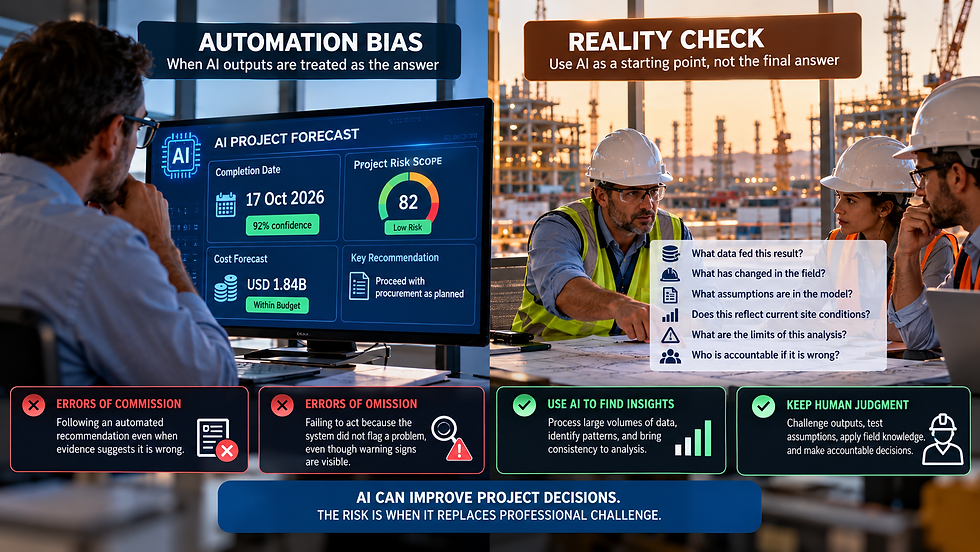
Strategic Misrepresentation in Project Business Cases: Why Realism Wins

A project business case can fail long before the first contract is awarded. The damage often starts when an early estimate is too low, a schedule is too neat, a benefit forecast is too confident, or a risk register is written to reassure rather than inform.
In complex capital projects, that problem is rarely simple. Poor forecasts can come from uncertainty, weak data, immature design, optimism bias, market volatility, or genuine error. They can also come from something more difficult to discuss: strategic misrepresentation, where costs, benefits, schedules, risks, or delivery assumptions are presented more favorably than the evidence supports to secure approval, funding, or executive backing.
That distinction matters. Treat every bad forecast as incompetence, and you miss the system pressures that shape early numbers. Treat every bad forecast as misconduct and people stop escalating bad news. Mature project governance needs a better lens. It needs to ask not only whether a forecast was wrong, but why the organization accepted it.
What Strategic Misrepresentation Is And What It Is Not
Strategic misrepresentation is the deliberate or semi-deliberate shaping of a project case to make approval more likely. It can involve understating cost, compressing schedule, inflating economic or social benefits, downplaying risks, assuming best-case productivity, or treating unresolved scope as if it were settled.
The key issue is not that the forecast later proves wrong. The issue is whether the evidence available at the time supported the level of confidence presented to decision makers.
A sponsor may present a project as affordable by excluding owner’s costs, interface risks, escalation, permitting delays, commissioning complexity, or contingency appropriate to the design's maturity. A contractor may price aggressively to secure position, expecting variation recovery later. A public agency may rely on high demand forecasts because the project has already become politically committed. A mining or energy developer may emphasize upside production scenarios while giving less attention to execution risk in remote logistics, workforce availability, or permitting.
That is different from genuine forecasting error. In early development, many facts are unknown. Subsurface conditions may differ from survey data. Commodity prices may shift. Regulatory requirements may change. Supply chain capacity may tighten. Weather, productivity, local market conditions, and contractor performance are all uncertain.
It is also different from optimism bias, although the two can overlap. Optimism bias is a human tendency to expect better-than-average outcomes and underweight difficulties. Research on major projects, including work widely associated with Bent Flyvbjerg and colleagues, has long argued that optimism bias and strategic behavior both contribute to poor megaproject forecasts. Professional bodies and government infrastructure guidance in several jurisdictions now recognize the need to correct optimism bias and use external benchmarks.
The difference is useful in practice:
Forecast problem | Typical pattern | Governance response |
Genuine error | The team used available evidence but made a reasonable judgment that proved wrong | Improve data, methods, and lessons learned |
Incomplete information | Key design, market, or site facts were not known at the decision point | Use ranges, staged approval, and defined assumptions |
Optimism bias | The team believed the favorable case more strongly than evidence justified | Apply challenge, reference classes, and probabilistic analysis |
Strategic misrepresentation | The case was framed more favorably to win approval or funding | Address incentives, assurance, transparency, and decision rights |
The hard cases sit in the middle. A team may not falsify anything, yet still filter the story. A risk may be listed but never priced. A schedule may show key permits as “to be confirmed” while the approval paper treats the date as firm. A benefits model may disclose assumptions in an appendix while the executive summary presents the upside as the base case.
That is why the language of fraud or incompetence often misses the point. In many organizations, unrealistic commitments become normalized through small moves that each feel defensible.
Why Unrealistic Business Cases Survive Scrutiny
Most project professionals know when an early case feels too clean. The question is why such cases still pass gates.
The answer usually sits in the project environment, not just in the estimating system.
Institutional Pressure Favors The Project That Can Be Approved
Capital allocation is competitive. Business units, asset owners, ministries, utilities, and joint ventures all compete for limited funding. A project that carries the full cost of uncertainty may look less attractive than one that presents a narrower, cleaner case.
That creates a subtle incentive. Teams learn what gets approved. A refinery turnaround, transmission upgrade, port expansion, offshore modification, or mine development may need to compete against other options. If the organization rewards confidence more than realism, then confidence becomes part of the business case.
This does not always mean someone is acting dishonestly. A development team may fear that presenting a wide cost range will make executives see the project as immature. An owner’s team may worry that a realistic contingency will be treated as inefficiency. A commercial team may believe a conservative schedule will cost them market opportunity. Over time, the organization trains teams to remove discomfort from the decision.
Political And Commercial Commitments Can Arrive Before The Facts
Major infrastructure and industrial projects often serve wider purposes. They support energy security, economic development, decarbonization, capacity growth, national infrastructure plans, or community commitments. Those aims can be valid. The risk appears when public or executive commitment comes before the business case earns it.
Once a project has a public promise, a fixed opening date, or a strategic announcement, the forecast can become a justification device. The team may still run analysis, but the range of acceptable answers narrows. Cost or schedule warnings become “challenges to solve” rather than decision information.
This pattern can appear in government transport programs, renewable energy hubs, utility upgrades, defense infrastructure, liquefied natural gas developments, and large industrial expansions. The context changes, but the pressure is familiar. Once the organization has said “we will,” the business case struggles to say “not yet.”
Sponsor Incentives Can Distort What Gets Shown
A sponsor’s role is to advocate for value, but advocacy can blur into selection bias. Project sponsors are often measured on growth, approvals, portfolio expansion, production targets, capital deployment, or market position. Those measures can push business cases toward approval-friendly framing.
In EPC and construction markets, the incentive pattern can be just as sharp. A contractor may bid low because work-winning targets matter now, while delivery risk sits later with project teams. A developer may approve a project on tight assumptions because delay threatens permits, financing, or offtake arrangements. A joint venture partner may support a low estimate because a more realistic one would trigger a difficult capital call.
AACE International’s recommended practices and cost engineering guidance place strong emphasis on estimate classification, basis of estimate, contingency, risk analysis, and maturity. PMI, APM, RICS, ICE, and other professional institutions all stress governance, transparency, and clear decision information in different ways. The common message is simple: good decisions require more than a number. They require the evidence behind the number.
Weak Independent Challenge Lets Convenience Look Like Confidence
Independent assurance does not guarantee accuracy, but weak challenge makes strategic framing easier.
The concern is not only whether assurance exists. It is whether it has authority, independence, time, and access to the real assumptions. A gate review held after the investment paper is already socially committed will struggle to change the decision. A peer review staffed by people who report into the sponsor may avoid difficult findings. A risk workshop chaired around the desired approval date may produce polite risk language rather than usable challenge.
Strong assurance asks uncomfortable questions early:
What has to be true for this estimate to hold?
Which assumptions are outside the project team’s control?
What is the evidence for the productivity rates?
Which risks are identified but not priced?
How does this compare with similar delivered projects?
What decision would change if the cost range were wider?
Are benefits tracked with the same discipline as costs?
The answers often matter more than the headline estimate.
The Commercial Cost Of Approval-friendly Forecasts
An unrealistic business case doesn't just create a reporting problem. It changes the project’s delivery path.
Cost Growth Becomes Harder To Manage
When the approved budget is too low, the project starts life in recovery mode. Contingency gets consumed by known unknowns that should have been expected. Management reserve becomes a political buffer rather than a risk-based allowance. Scope freezes become tense because the installed budget never matched the intended asset.
This is common in early EPC and infrastructure estimates where design maturity is limited. If the estimate excludes credible allowances for ground conditions, logistics, utility diversions, brownfield interfaces, marine weather windows, commissioning spares, or the owner’s integration scope, those costs don't disappear. They return later as change orders, claims, reforecasts, or scope cuts.
A low initial number can also distort procurement. The owner may select delivery strategies that look affordable only under ideal market conditions. Packages may be split in ways that transfer interface risk back to the owner. Long-lead items may be deferred to hold a sanction number, then procured under schedule pressure.
Schedule Delay Becomes Baked In
Schedule misrepresentation often looks like logic without probability. The plan may contain all activities, but it assumes smooth handovers, fast approvals, available labor, clean interfaces, no rework, and timely decisions.
In complex projects, schedule risk is rarely a single critical path issue. It sits in accumulated interfaces. A utility substation upgrade relies on outage windows. A rail program depends on possessions, permits, land access, systems integration, and testing. A mining plant depends on camps, roads, modular transport, wet commissioning, and operator readiness. An offshore campaign depends on vessels, weather, SIMOPS controls, fabrication quality, and hook-up sequencing.
If the business case treats the earliest credible date as the commitment date, delay becomes likely before execution begins. The team then spends delivery explaining why reality didn't match the approval narrative.
Contingency Erosion Damages Decision Quality
Contingency is often misunderstood. It is not spare money. It is an allowance for uncertainty and risk within a defined scope and basis. AACE and other cost engineering bodies have long emphasized the need to tie contingency to estimate maturity and risk.
When organizations squeeze contingency to make a project pass an economic hurdle, they lose a key control. Early drawdown may look like poor delivery performance, when the real issue is that the project had no credible risk allowance. Teams then respond by hiding emerging cost pressures, delaying forecasts, or trading off quality and maintainability to stay inside budget.
That can damage long-term asset performance. A project delivered by trimming commissioning time, reducing access provisions, deferring reliability improvements, or accepting marginal maintainability may meet an opening milestone but burden operations for years.
Scope Change And Claims Become More Likely
Understated scope creates commercial stress. Contractors priced on incomplete information will protect themselves through exclusions, qualifications, claims, or variation routes. Owners who believed the original estimate may see later changes as opportunistic. Both sides can be partly right.
Many claims in construction, EPC, and infrastructure grow from misaligned expectations at contract formation. If the sanctioned case assumed design completeness, clear access, stable quantities, or rapid approvals, but the contract reality differs, conflict becomes much more likely. Strategic misrepresentation in project business cases can therefore migrate into procurement strategy, risk allocation, and contract administration.
The result is not only higher cost. It also slows decision-making, creates defensive records, damages relationships, and exhausts executives.
Why Misconduct Is The Wrong Default Explanation
Experienced professionals have seen forecasts that were plainly unrealistic. The temptation is to ask who signed them off and why they failed. Accountability matters, but a narrow blame model can make the next business case worse.
A more useful question is how the system made unrealistic commitments feel normal.
Unrealistic Commitments Often Grow By Increments
Most approval-friendly forecasts do not begin with a dramatic act. They grow through small edits:
A risk is moved from the cost model to a watchlist.
A schedule range becomes a single date for the steering paper.
A benchmark is dismissed because “our project is different.”
A contingency figure is reduced to meet an investment hurdle.
A benefit ramp-up curve assumes fast adoption without operating evidence.
A scope gap is labeled as future value engineering.
A confidence level is not stated, so the base estimate sounds more certain than it is.
Each step has a rationale. The risk is not certain. The date is needed for planning. The benchmark includes projects with different conditions. The contingency will be managed. The benefit is strategic. The scope will be controlled. The base estimate is standard practice.
Together, those choices can turn a fragile case into an approved commitment.
Governance Can Confuse Challenge With Disloyalty
In some organizations, the project development team is expected to be positive. Raising doubts can be seen as a lack of ownership. Assurance reviewers may be told to help the team “get through the gate.” Risk managers may be invited late and asked to validate rather than challenge.
That culture is commercially dangerous. Early escalation is cheaper than late correction. A difficult gate decision may protect capital, reputation, and delivery capacity. Yet people will not surface weak assumptions if doing so damages careers or labels them as blockers.
APM and PMI both place strong emphasis on governance, stakeholder engagement, risk management, and ethical conduct. OECD and World Bank guidance on public investment and infrastructure governance also stress transparency, appraisal quality, and institutional accountability. The exact language differs across frameworks, but the direction is consistent: decision systems should make reliable information valuable.
Forecast Accuracy Is Not The Only Measure Of Integrity
A business case can be credible even if later events change. The standard should not be perfect prediction. It should honestly represent uncertainty.
A credible early business case says:
what is known
what is assumed
what has been benchmarked
what remains unresolved
what range of outcomes is plausible
what would trigger review or reapproval
how benefits will be measured after approval
That is very different from presenting a single attractive number with a long appendix of caveats that nobody uses in the decision.
Controls That Make Realism Easier To Approve
Controls do not remove judgment. They improve the conditions under which judgment is made.
Separate Advocacy From Approval
Project sponsors should advocate for value. Approval bodies should test whether the value case is credible. When the same group shapes, promotes, and approves the business case, challenge weakens.
A stronger model separates roles:
The sponsor owns the business need and case for change.
The project team develops scope, cost, schedule, risk, and delivery strategy.
Independent assurance tests assumptions and evidence.
The investment committee makes the decision with clear confidence levels.
Operations or asset owners validate benefits, maintainability, and readiness.
This separation does not need to be bureaucratic. For smaller capital projects, it may be a light but independent review. For major programs, it may involve staged gates, external assurance, cost reviews, constructability reviews, and operational readiness checks.
Use Reference-class Forecasting And Benchmarking
Reference-class forecasting compares a proposed project with outcomes from similar completed projects. It helps counter the belief that the current project is uniquely controllable.
This method is widely discussed in major project research and has influenced infrastructure appraisal guidance in several countries. The practical value is direct. If similar rail, road, bridge, power, water, offshore, or process plant projects often faced specific categories of overrun, the business case should explain why this project will differ.
Benchmarking should not be used as a blunt average. Good benchmarking adjusts for scope, location, market conditions, delivery model, design maturity, procurement route, regulatory setting, and asset complexity. Poor benchmarking cherry-picks favorable comparators.
Useful benchmarks include:
unit rates and installed quantities
engineering hours by deliverable maturity
procurement lead times
construction productivity
contingency by estimate class
commissioning and ramp-up durations
historical change rates
benefits realization curves
The point is not to replace project-specific estimates. The point is to challenge whether those estimates align with credible experience.
Use Probabilistic Estimates And Confidence Ranges
Single-point estimates invite false certainty. Probabilistic cost and schedule analysis shows a range of possible outcomes and the confidence associated with them.
For example, a project may have a base estimate, a risk-adjusted expected outcome, and higher-confidence funding values. The approval paper should clearly state which number is used for sanction, which risks are included, and the confidence level the organization accepts.
The same applies to schedule. A date can be technically possible and still commercially unwise to commit to. A probabilistic schedule can show the difference between an aggressive target, a likely completion window, and a high-confidence commitment date.
Probabilistic analysis is only as good as the inputs. If risk workshops are biased, correlations ignored, or assumptions politically constrained, the model will still flatter the case. It needs independent challenge and transparent assumptions.
Make Assumptions Visible And Testable
Every business case relies on assumptions. The issue is whether they are clear enough to challenge.
A strong assumption register should identify:
the assumption owner
the evidence source
the confidence leveldistinguish an aggressive target from a likely completion window
the decision impact
the expiry point
the trigger for review
the link to cost, schedule, risk, and benefits
This is especially useful in early-stage energy, mining, utilities, and infrastructure work, where external dependencies can dominate outcomes. Land access, grid connection, permits, water rights, marine windows, community agreements, geotechnical data, feed composition, technology maturity, and offtake conditions can each change the business case.
A visible assumption is governable. A hidden assumption becomes a surprise.
Track Benefits With The Same Discipline As Costs
Many organizations challenge capital cost harder than benefits. That imbalance encourages inflated value cases.
Benefits should have owners, baselines, measurement methods, timing assumptions, and post-approval tracking. If a power project claims reliability improvement, define how reliability will be measured. If a port expansion claims throughput growth, test the demand, landside logistics, and operational constraints. If a digital control system claims reduced downtime, link the claim to maintenance records, operating behavior, and asset condition.
Transparent benefit tracking makes the organization learn. It also reduces the incentive to inflate benefits for approval and forget them after sanction.
Keep A Clear Decision Log
Decision logs are not administrative clutter when used well. They preserve what was known, what was assumed, who accepted which risk, and why the project moved forward.
A good decision log helps later teams distinguish poor delivery from changed context or knowingly accepted risk. It also improves accountability without relying on memory. In claims, audits, and post-project reviews, contemporaneous decision records often matter more than polished summaries written later.
How Governance Can Reward Realism Without Creating Fear
The goal is not to make project teams pessimistic. Capital projects require confidence, leadership, and commitment. The goal is to make confidence evidence-based.
A no-blame culture does not mean no accountability. It means people can raise uncertainty early without being punished for honesty. Accountability then focuses on the quality of thinking, the transparency of evidence, and the discipline of response.
Governance can support that balance in several ways.
Treat Ranges As Maturity, Not Weakness
Early projects should not be forced into false precision. A concept estimate for a remote mine, offshore facility, desalination plant, transmission corridor, industrial expansion, or major civil program should carry wider ranges than a detailed control estimate. That is a sign of professional discipline.
Executives can help by asking for confidence ranges, not just lower numbers. They can ask what would reduce uncertainty, which decisions are irreversible, and how much to spend to improve definition before sanction.
Fund Development Properly
Weak business cases often reflect underfunded development. Site investigation, front-end engineering, constructability planning, market testing, environmental studies, operational input, and risk analysis cost money. Skipping them can make early numbers look attractive while pushing risk into execution.
Front-end loading doesn't guarantee success, but poor development increases the chance of avoidable surprises. Many professional institutions and government infrastructure bodies stress early definition, option appraisal, and disciplined stage gates for this reason.
Reward Early Escalation
Teams should not learn that bad news is safe only after the point of no return. A governance system should value early escalation as a control measure.
That means leaders need to respond well when forecasts worsen for valid reasons. If every increase is treated as failure, teams will wait. If leaders treat every challenge as obstruction, assurance will soften. If every contingency draw is treated as poor performance, risk reporting will become performative.
Better questions include:
Did the team identify the issue early?
Was the original assumption visible?
Has the range changed because evidence improved?
What decision is needed now?
Does continued investment still make sense?
What should the portfolio learn?
These questions keep accountability while protecting transparency.
Make Post-project Learning Real
Organizations often claim to value lessons learned, yet repeat the same approval patterns. A useful review connects original assumptions to actual outcomes. It should test cost, schedule, benefits, risk, claims, operational performance, and asset reliability.
The review should ask whether the business case was realistic for its maturity at the time. It should not merely compare final cost against the sanctioned budget. If the sanctioned budget excluded foreseeable risk, the lesson is not only “delivery overran.” It may be “approval accepted an underdeveloped case.”
Realism Is A Commercial Advantage
Realistic business cases can feel harder to approve because they expose uncertainty. In practice, they protect capital.
They help owners choose the right projects, set credible funding, select suitable delivery models, negotiate fair contracts, and maintain trust with boards, regulators, lenders, partners, communities, and delivery teams. They reduce the gap between the promise made at sanction and the conditions faced in execution.
Strategic misrepresentation is not solved by better templates alone. It is reduced when incentives, governance, and leadership behavior make realism safer than optimism. Independent assurance, reference-class forecasting, benchmarking, probabilistic estimates, assumption challenge, confidence ranges, benefit tracking, and decision logs all help. Yet the deeper control is cultural and commercial: reward the person who brings evidence, not just the person who brings approval.
Credible project approval depends on a simple discipline. Projects should compete on real value, not on the most attractive version of uncertainty. Realism wins because it gives decision makers what they actually need: a clear view of the commitment they are about to make.